
Traffic hits your site every day. Visitors land on your blog, scroll through your service pages, then leave without buying anything. This is the quiet frustration behind most marketing budgets. Numbers on a dashboard look great, but the phone does not ring, and the cart stays empty. The real problem is not traffic. It is a lack of strategy that connects that traffic to a purchase decision. A content marketing agency that understands this gap can turn passive visitors into paying customers, and this article breaks down exactly how that happens.
Get a Free Content and Traffic Audit

 Chat on WhatsApp
Why Traffic Alone Doesn’t Guarantee Customers
A high number of visitors means nothing if those visitors leave within seconds. Many sites report strong traffic numbers alongside bounce rates above 70 percent, which tells you people arrive and immediately decide the page is not for them. The mismatch usually comes down to intent. A visitor searching for pricing information lands on a generic blog post, or someone ready to buy gets served an article written for someone still researching.
Pages also fail because they never ask for anything. A visitor reads a full article, nods along, then reaches the bottom with no clear next step. Without a call to action tied to that specific content, even engaged readers just close the tab.
- High bounce rate despite good traffic numbers
- Mismatched content and buyer intent
- Weak or missing calls to action on pages
What Sets the Best Content Marketing Agencies Apart
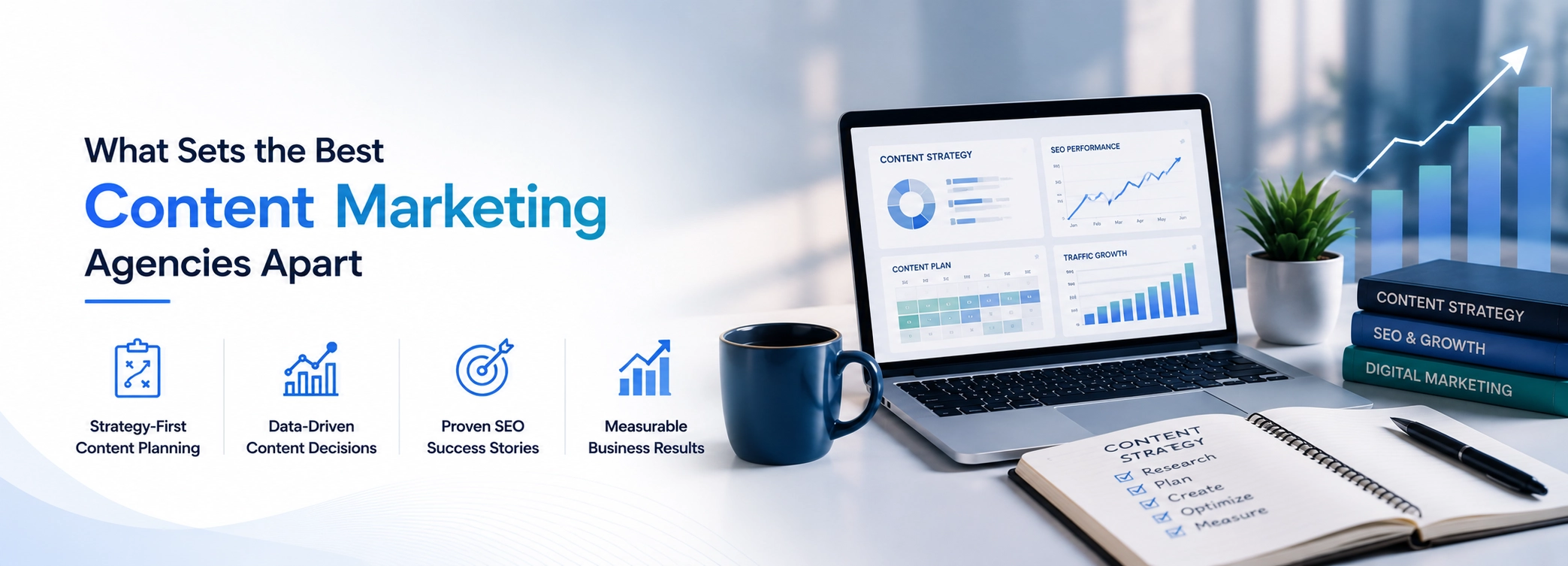
Plenty of agencies publish articles on a schedule and call it a strategy. The best content marketing agencies do something different. They start with research, map out where a business actually loses potential customers, and build content around closing those gaps rather than just filling a calendar.
Data drives every decision at this level. Rather than guessing which topics might work, strong agencies track what readers already search for, what competitors rank for, and what converts inside a specific industry. They also bring proof to the table: real case studies with real numbers, not vague promises about “brand awareness.”
- Strategy-first approach, not just publishing volume
- Data-backed content decisions
- Proven case studies and measurable results
The Role of a Content Marketing Consultant in Growth Strategy
A content marketing consultant looks at a business from the outside and spots what internal teams often miss. They audit existing content, flag pages that repeat the same keyword without adding value, and identify topics competitors already own that a business has never touched.
Beyond the audit, a consultant connects content to the sales funnel. They ask which stage each blog post or landing page serves and whether that matches what the sales team actually needs. Messaging and positioning fall under this role too, since a consultant often catches inconsistent brand voice before it confuses potential buyers.
- Auditing existing content gaps
- Aligning content with sales funnel stages
- Advising on messaging and positioning
How a Content Marketing Specialist Shapes Buyer Journeys
A content marketing specialist builds each piece of content around where a reader sits in their decision process. Someone at the awareness stage needs education, not a hard sell. Someone at the decision stage needs proof, pricing clarity, and a reason to choose one company over another.
Writing for intent matters more than chasing keyword volume alone. A specialist studies search phrases and figures out what the person typing that phrase actually wants to find. Older content gets revisited too, since a specialist will update and optimize existing pages instead of abandoning them the moment a new post goes live.
- Mapping content to awareness, consideration, decision stages
- Writing for intent, not just keywords
- Optimizing existing content for conversions
Content Marketing and SEO: Why They Can’t Work Separately
Great content published without SEO support tends to sit unread on page five of search results. All the research and writing in the world does not matter if nobody finds the page. SEO gives content a way to reach the people searching for it in the first place.
The reverse holds true as well. SEO without strong content has nothing worth ranking. Search engines reward pages that answer a query fully, and a technically perfect page with thin writing rarely holds a top spot for long. Businesses that treat these two functions as one connected strategy consistently outperform those running them in separate silos.
Organic SEO Services That Support Real Conversions
Organic SEO services start with keyword intent research, meaning the goal is not just ranking for a term but ranking for the right term at the right stage of a buyer’s journey. From there, on-page optimization ties directly to content goals rather than existing as a separate technical checklist.
Technical SEO plays a supporting role behind the scenes. Site speed, mobile usability, and clean site structure all affect whether a visitor sticks around long enough to convert. None of that technical work matters without content built to hold attention once someone lands.
- Keyword intent research
- On-page optimization tied to content goals
- Technical SEO support for content performance
Choosing an Organic SEO Agency vs a Paid Traffic Agency
Paid ads bring visitors fast, but that traffic disappears the moment a budget runs dry. An organic SEO agency builds something that keeps generating traffic long after the initial work wraps up, which changes the entire cost equation over time.
Trust plays a role too. Many searchers skip paid ad placements entirely and click on organic results instead, since organic rankings carry a sense of credibility that paid placement does not automatically provide. A business relying only on paid traffic never builds that same long-term trust with its audience.
- Cost differences over time
- Sustainability of organic results vs paid dependency
- Trust and credibility factors with organic rankings
Comparison Table 1: Organic SEO Agency vs Paid Advertising Agency
| Factor | Organic SEO Agency | Paid Advertising Agency |
| Cost over 12 months | Front-loaded, drops over time | Constant, scales with ad spend |
| Traffic sustainability | Builds and compounds | Stops when budget stops |
| Trust building | Higher due to organic ranking | Lower, seen as an ad |
| Long-term ROI | Strong after initial period | Flat, tied to spend |
| Content ownership | The business owns all content assets | Ad copy has limited reuse |
What to Expect From an Organic SEO Consultant
An organic SEO consultant builds a plan around the specific business rather than applying the same template to every client. “Personalized strategy” means a local dental practice and a national e-commerce brand get completely different roadmaps, since their audiences and competition look nothing alike.
Direct communication sets a consultant apart from a large agency where a business might never speak to the person actually doing the work. Regular reporting keeps everyone aligned on what is working, and a consultant often offers more flexibility for smaller budgets than a full-service agency can.
- Personalized strategy vs. one-size-fits-all agency approach
- Direct communication and reporting
- Flexibility for smaller budgets
How Organic SEO Agencies Build Long-Term Traffic That Converts
Organic SEO agencies rely on topic clusters rather than random one-off articles. A cluster groups related content around a core topic, which helps search engines understand the depth of expertise on a subject and helps readers find related information without leaving the site.
Authority also builds through backlinks and mentions from other credible sites. Consistent publishing matters here too, since a single burst of content followed by months of silence rarely holds ranking gains. Agencies that keep a steady cadence tend to see traffic climb steadily rather than spike and fade.
- Topic cluster strategy
- Authority building through backlinks and mentions
- Consistent content publishing cadence
Why a SaaS Content Marketing Agency Needs a Different Approach
A SaaS content marketing agency deals with longer sales cycles than most other industries. Buyers research for weeks or months, compare multiple tools, and often need several touchpoints before signing up for a trial. Content built for that reality looks different from content built for an impulse purchase.
Trial signups and demo requests become the real goal rather than a simple purchase button. Educational content also outperforms promotional content in this space, since technical buyers tend to trust a company that teaches them something over one that just pitches features.
- Longer sales cycles and technical buyers
- Content built for trial signups and demos
- Educational content over promotional content
What a Content Marketing Manager Actually Oversees
A content marketing manager keeps the entire operation running on schedule. That means managing a content calendar, coordinating writers and editors, and making sure every piece ships on time without sacrificing quality.
Performance tracking falls under this role as well, since a manager reviews how each piece performs across channels and adjusts the plan accordingly. Every decision ties back to business goals rather than vanity metrics like page views alone.
- Content calendar and team coordination
- Performance tracking across channels
- Aligning content with business goals
Content Marketing SEO Services: What’s Usually Included
Content marketing SEO services typically start with keyword research paired with detailed content briefs so writers know exactly what to cover before they start a draft. This step alone prevents a huge amount of wasted effort later.
On-page SEO optimization follows once a draft exists, covering title tags, headers, and internal links. Performance reporting closes the loop, giving a business clear visibility into what content earns rankings and what needs a second look.
- Keyword research and content briefs
- On-page SEO optimization
- Performance reporting and adjustments
Redefining Web structures its own service offering around this exact model, pairing keyword strategy with on-page work and reporting under one roof instead of splitting the two functions across separate vendors.
Signs Your Current Content Strategy Isn’t Converting
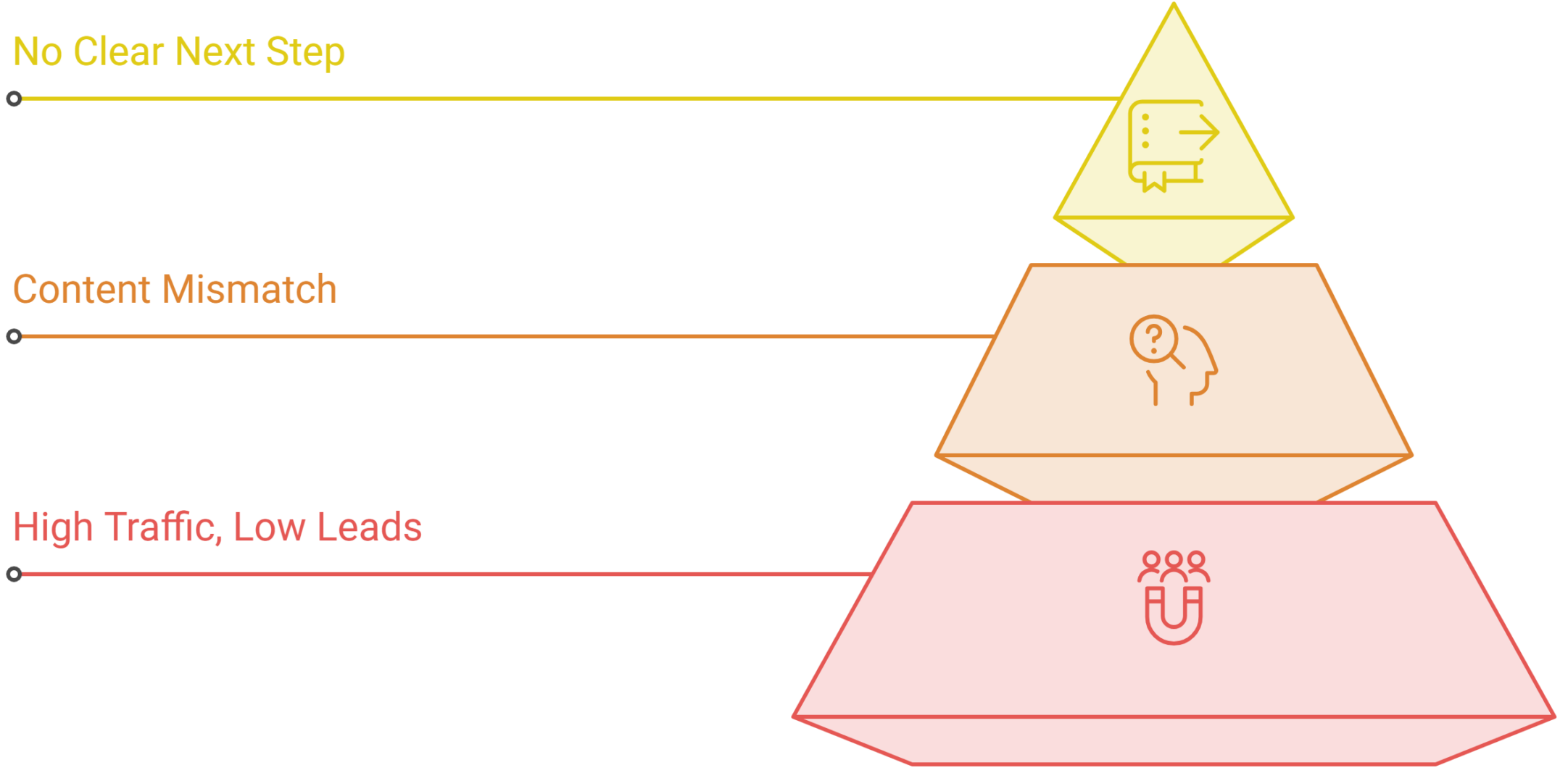
High traffic paired with low leads is the clearest warning sign a strategy has a gap somewhere. Visitors show up, but almost none of them take the next step toward becoming a customer.
Content that does not match what customers actually search for causes a similar problem, since a mismatch between search intent and page content sends visitors away confused. A page with no clear next step compounds the issue further, leaving even interested readers with nowhere to go.
- High traffic, low leads
- Content not matching what customers search for
- No clear next step for readers
How the Right Content Marketing Agency Turns Blog Readers Into Leads
The right content marketing agency places calls to action with intent rather than dropping the same generic button on every page. A blog post about a specific problem gets a call to action tied directly to solving that exact problem, which converts far better than a vague “contact us” link.
Lead magnets tied to content topics give readers a reason to share their email in exchange for something useful, like a checklist or guide related to what they just read. Nurturing sequences then keep that relationship going after the first interaction, guiding a reader toward a purchase decision over time.
- Strategic CTA placement within content
- Lead magnets tied to content topics
- Nurturing sequences after content engagement
Comparison Table 2: In-House Content Team vs Hiring a Content Marketing Agency
| Factor | In-House Content Team | Content Marketing Agency |
| Cost | Salaries, benefits, tools | Flexible retainer or project-based |
| Expertise range | Limited to hired staff | Broad, spans writers, SEO, strategy |
| Scalability | Slow, requires new hires | Fast, scales with contract terms |
| Time to results | Depends on team experience | Often faster due to proven process |
| Tools and technology access | Requires separate purchase | Usually included in service |
How to Measure If Your Content Marketing Strategy Is Working
Conversion rate tells a far more honest story than traffic alone. A page with modest traffic but a strong conversion rate often outperforms a high-traffic page that converts almost nobody.
Lead quality matters just as much as lead quantity, since ten qualified leads beat a hundred unqualified ones every time. Customer acquisition cost from organic content rounds out the picture, showing whether the strategy actually saves money compared to paid channels over time.
- Conversion rate, not just traffic
- Lead quality over lead quantity
- Customer acquisition cost from organic content
Questions to Ask Before Hiring a Content Marketing Agency
Past client results and case studies reveal more than any sales pitch ever will. A business should ask to see specific numbers, not just a list of logos.
Reporting transparency matters too, since a business deserves clear visibility into what work gets done each month. It also helps to ask whether SEO and content get handled together or separately, since a split approach often creates the same disconnect discussed earlier in this article.
- Past client results and case studies
- Reporting transparency
- Whether SEO and content are handled together or separately
Building a Content Strategy That Grows With Your Business

Most businesses should start with core service pages and a solid blog foundation before expanding into anything more complex. These foundational pages capture the bulk of early search traffic and give a site something solid to build on.
From there, a strategy can scale into video, in-depth guides, and gated content that captures leads directly. Older content deserves regular attention too, since revisiting and updating existing pages often produces better returns than publishing something brand new.
- Starting with core service pages and blog foundation
- Scaling into video, guides, and gated content
- Revisiting and updating older content regularly
Why Consistency Matters More Than Volume in Content Marketing
Quality beats quantity every time search engines evaluate a site. A handful of well-researched, well-written pages will outperform a flood of thin content published just to hit a number.
Consistent content compounds over months and years, building authority a business simply cannot rush. Publishing schedules should stay realistic too, since burnout from an unsustainable pace often leads to a sharp drop in quality right when momentum starts to build.
- Quality over quantity in publishing
- Long-term compounding effect of consistent content
- Avoiding burnout from unsustainable publishing schedules
Conclusion
Traffic without a plan behind it rarely turns into revenue, no matter how many visitors land on a site each month. The right content marketing agency connects content, SEO, and conversion goals into one strategy instead of three disconnected tasks, and that connection is what actually moves a visitor toward a purchase. Companies like Redefining Web have shown how pairing strategic content with organic SEO produces results that paid traffic alone cannot match over time.
Book a Free Strategy Consultation
Frequently Asked Questions About Content Marketing Agency


Know your website’s SEO Score.
Get a customized SEO Audit report & improve your website statistics.