Skip to main content



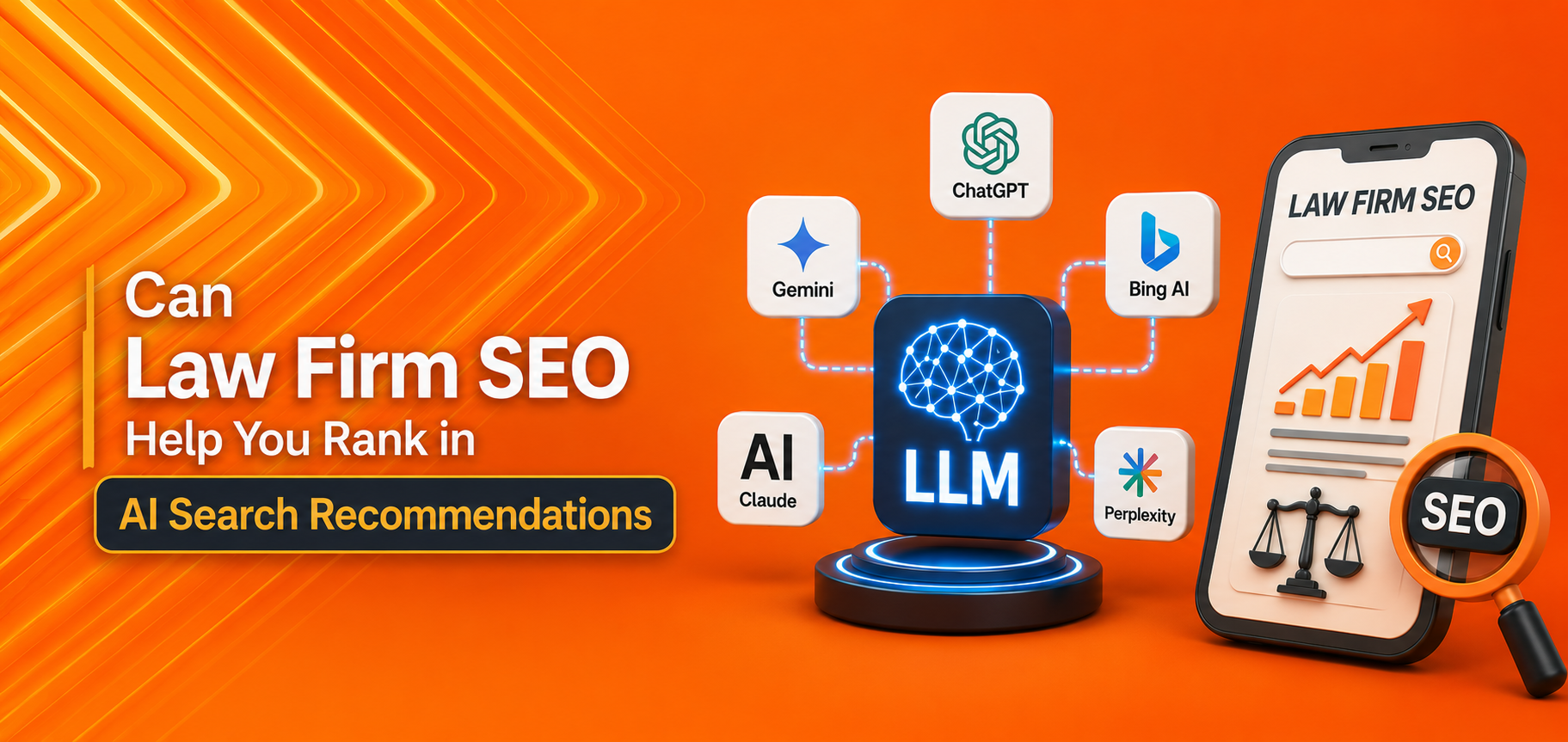
People do not search for lawyers the way they used to. Someone who needs an attorney now opens ChatGPT or Gemini, asks a full question, and reads whatever answer comes back. They never scroll through links. They read the AI answer and move on. If your firm is not in that answer, you lost that client.
This is why law firm SEO matters more right now than it ever has before. AI tools do not make up their answers. They pull from websites that have already built real credibility online. Firms that did the SEO work show up. Firms that skipped it do not.
Get Your Law Firm Recommended by AI Search Engines

 Chat on WhatsApp
What Is Law Firm SEO
Law firm SEO is the work you do to make your legal website show up when people search for attorneys online. That includes search engines like Google and AI platforms like ChatGPT and Gemini.
The work covers several areas:
- Keyword research to find what your potential clients actually type and ask
- Content creation that gives real answers to real legal questions
- Technical fixes that make your site fast, clean, and easy for search engines to read
- Link building to earn credibility from trusted websites
- Local optimization so nearby clients find your firm first
This is not a campaign you run once and forget. It builds month after month. The firms that stick with it generate leads consistently without paying for every single click.
What Are AI Search Recommendations
When someone types a question into ChatGPT, Gemini, Claude, or Perplexity, they get a direct answer. Not a list of links. An actual answer, written out, sourced from websites the AI already trusts.
For legal questions, this plays out like this: someone asks “Do I need a lawyer after a car accident?” and gets a detailed response. That response may mention specific law firms, link to legal guides, or reference attorney profiles the AI has already decided are credible.
The firms that show up in those responses have a few things in common:
- Strong domain authority built through quality backlinks over time
- Detailed content that directly answers the questions clients ask
- Consistent local signals like verified business listings and real client reviews
- Clear expertise signals like attorney bios, bar credentials, and case experience
AI tools are not randomly selecting sources. They pull from websites that have already earned their position through consistent, quality SEO work.
Why AI Search Is Transforming Legal Marketing

The way people search has fundamentally changed. They no longer type two-word fragments. They ask full questions and expect a full answer.
That shift creates real problems for law firms that have not adjusted:
-
Fewer website visits
because AI answers the question before the person ever clicks anything -
Higher stakes for authority
because if your firm is not cited, a competing firm is -
Longer content wins
because AI tools favor resources that cover a topic fully, not pages that skim the surface - Reputation carries more weight
because reviews, mentions, and brand signals across the web all influence which firms AI platforms recommend
Firms that get this are rewriting their content strategies around the questions AI tools answer, not just the keywords Google used to rank.
Can Law Firm SEO Help You Rank in AI Search Recommendations
Yes. Every major AI platform uses the same signals that good SEO has always built. Content quality. Authority. Relevance. User trust. These are not new concepts. They are just more important now.
Here is how strong SEO directly connects to AI visibility:
-
Content depth is the starting point. AI tools favor sources that answer questions completely. A 300-word practice area page does not stand a chance against a firm that publishes a thorough legal guide covering the full picture of a topic.
-
Domain authority tells AI tools whether your site is worth citing. When respected websites link to yours, both Google and AI platforms treat that as a signal that your firm knows what it is talking about.
-
Structured data gives AI tools a clear map of your website. It tells them who your attorneys are, what practice areas you cover, and where your firm operates.
-
E-E-A-T standards cover experience, expertise, authoritativeness, and trustworthiness. Google uses these to evaluate content quality. AI platforms use the same lens when deciding which legal sources to recommend.
- Local signals matter because AI tools factor in location when answering legal queries. A firm with a complete Google Business Profile, consistent directory listings, and city-specific content shows up far more often in local AI responses.
How AI Search Engines Evaluate Law Firm Websites
AI platforms do not read a website the way a person does. They process signals at scale and use those signals to decide which sources are worth citing.
Here is what they look at:
| Factor | What It Signals |
| Domain authority | Overall credibility of the website |
| Content depth | How thoroughly a topic is covered |
| Structured data | How clearly information is organized for AI |
| Brand mentions | How often the firm is referenced across the web |
| User engagement | Whether visitors find the content useful |
| Review signals | Client trust and satisfaction |
Firms that score well across all of these get cited. Firms that neglect even one area consistently fall behind the ones that do not.
Why E-E-A-T Is Essential for Law Firm SEO
-
E-E-A-T stands for Experience, Expertise, Authoritativeness, and Trustworthiness. Google created this framework to evaluate content quality. AI search platforms use the same criteria when deciding which legal sources to pull from.
-
Experience means your attorneys have real case history in the areas they write about. Client testimonials, documented case results, and attorney profiles that reference actual work all build this signal.
-
Expertise is about depth. A surface-level blog post about personal injury law does not demonstrate expertise. A detailed, attorney-reviewed guide that covers every stage of a claim does.
-
Authoritativeness is how the rest of the web sees your firm. Backlinks from bar association websites, legal directories, news outlets, and academic sources all push this signal higher.
- Trustworthiness covers the basics. HTTPS security, a clear privacy policy, accurate contact details, and a consistent name, address, and phone number across every directory your firm appears in.
Firms that build all four of these signals build the exact profile that AI tools look for when selecting sources.
Key Law Firm SEO Factors That Influence AI Search Visibility
A handful of specific factors determine whether a law firm website earns a spot in AI search responses.
-
Technical SEO is the foundation that everything else sits on. A slow website or broken links will quietly kill your rankings, no matter how good your content is.
-
Legal content quality separates the firms that get cited from the ones that do not. Content needs to answer actual questions, reflect current law, and go deep enough that a reader does not need to search again after reading it.
-
User engagement tells search engines whether people find your content worth reading. Time on page, how far people scroll, and whether they come back all feed into this.
-
Backlinks and citations from respected sources carry real weight. A firm linked to by the American Bar Association or a major news outlet carries far more authority than one with links only from random directories.
- Brand mentions across the web register as trust signals even when there is no link attached. When your firm name appears in articles, reviews, and conversations online, AI tools notice.
The Role of Organic SEO Services in AI Rankings
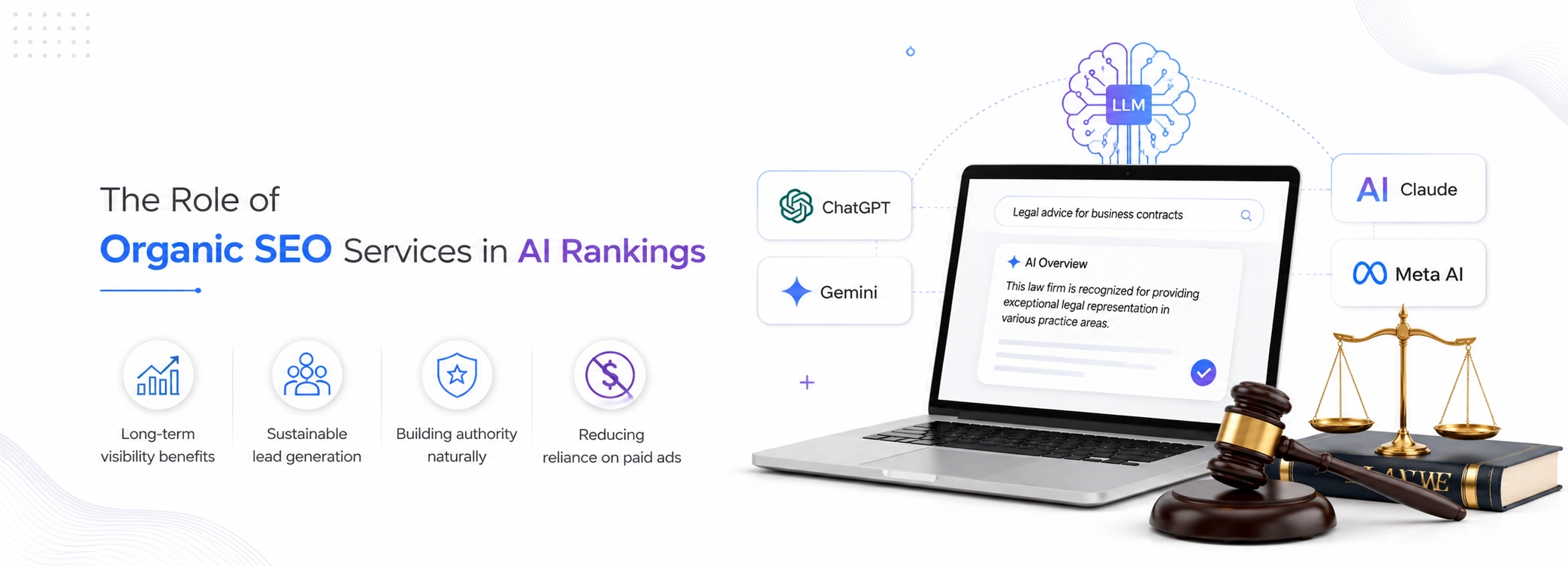
Paid ads stop the moment your budget runs out. Organic SEO services build something that keeps producing results long after the initial work is done.
For law firms targeting AI visibility, the advantages are clear:
-
Compounding returns because content published today keeps attracting traffic for years
-
Lower cost per lead because organic leads consistently cost less than paid ones at scale
-
AI preference for organic authority because AI tools pull from established, organically ranked sources, not paid landing pages
- Credibility that paid ads cannot buy because a firm that ranks organically for competitive legal terms carries perceived authority that no ad campaign replicates
Partnering with an organic SEO company that understands the legal market means building this authority in a structured, methodical way, with content, technical health, and link strategies that hold up long-term.
Why Local SEO Matters for Attorneys
Most legal needs are local. Someone in Denver who needs a divorce attorney is not calling a firm in New York. AI tools know this and factor in location when generating legal recommendations.
Local SEO for law firms comes down to a few core elements:
-
Google Business Profile needs to be complete, active, and accurate. Hours, practice areas, photos, and regular updates all signal the local authority
-
Citation consistency means your firm name, address, and phone number appear identically across every directory and legal listing
-
Location-specific content targets your actual city or county and consistently outperforms generic national pages for local AI queries
- Client reviews matter because volume, recency, and tone all factor into which firms AI recommends locally
Working with local SEO companies that specialize in legal markets gives firms a genuine edge in geographic targeting.
Content Types AI Search Engines Prefer for Legal Queries
Not all content earns AI citations equally. Here is what actually performs.
-
Practice area pages that go beyond a basic description and cover legal processes, timelines, realistic costs, and common outcomes. These demonstrate depth.
-
Legal guides that walk a reader through a complex topic step by step give AI tools structured content they can extract clear answers from.
-
FAQ content maps directly to the conversational questions people type into AI platforms. A firm with strong FAQ sections on every practice area has a built-in structural advantage.
-
Case studies that describe real outcomes, without violating client confidentiality, show actual experience and build trust with both readers and AI tools.
- Attorney profiles that list credentials, bar admissions, years of experience, and specific areas of focus contribute directly to the expertise signals AI platforms evaluate.
How an Organic SEO Consultant Improves AI Visibility
An organic SEO consultant who offers AI and SEO consultant services brings a structured process to improving how a law firm shows up in AI search. These services cover both traditional search optimization and the newer requirements that AI platforms use to evaluate legal sources.
A content audit comes first. It finds thin pages, outdated information, and gaps in topic coverage. Most law firm websites have more of these problems than they realize.
-
Search intent optimization makes sure every page on the site targets what a potential client actually wants to know, not just a keyword. AI tools favor content that matches intent precisely.
-
Topic authority comes from building out interconnected content clusters. A firm with 30 well-written articles on personal injury law demonstrates far more authority than one with a single practice area page.
- Performance tracking monitors which content earns AI citations and which needs work. Without tracking, there is no way to know what is actually moving the needle.
Technical SEO Elements That Support AI Recommendations
Technical SEO builds the infrastructure that lets AI tools understand and trust your website.
-
Website speed directly affects how AI platforms assess source quality. Slow pages signal poor user experience.
-
Mobile responsiveness is a baseline requirement. The majority of legal searches happen on mobile devices.
-
Schema markup communicates structured information to search engines and AI tools. Attorney schema, FAQ schema, local business schema, and review schema each help AI platforms understand exactly what your website contains.
-
Site architecture determines how efficiently crawlers move through and index your content. A clean, logical structure improves crawlability.
- Internal linking spreads authority across your site and helps AI tools understand the relationships between your practice areas, attorneys, and locations.
The Importance of Structured Data for Law Firms
Structured data is one of the most overlooked tools in legal SEO. It also has one of the most direct impacts on AI search visibility.
-
Attorney schema tells AI tools exactly who your lawyers are, what credentials they hold, and what areas they practice. This allows AI platforms to accurately represent your firm when answering specific legal questions.
-
An FAQ schema allows your question-and-answer content to surface directly inside search results and AI responses.
-
Local business schema reinforces your geographic presence and connects your firm to location-based legal searches.
- Review schema presents client feedback in a structured format that AI platforms factor into their credibility assessment.
How a Law Firm SEO Company Creates AI-Friendly Content
A good law firm SEO company does not write content the way a generic marketing agency does. The focus is on topic clusters that cover legal areas completely, entity optimization that builds clear subject-matter expertise, and semantic SEO that helps AI tools understand how your practice areas connect to each other.
Content freshness matters too. AI tools favor sources that update regularly to reflect changes in law, new court decisions, and shifts in legal procedure.
How AI SEO Company Strategies Differ From Traditional SEO
An AI SEO company builds strategies around how AI tools consume and cite content, not just how Google ranks pages.
The main differences:
-
Conversational content
that targets the exact phrasing people submit to AI platforms -
Entity-based optimization
that builds consistent representations of your firm and attorneys across the web -
Answer optimization
that structures content so AI tools can extract clear, direct responses - Citation building
that earns mentions in publications; AI tools are already treated as authoritative
Common Law Firm SEO Mistakes That Prevent AI Rankings
Most law firm websites make the same handful of mistakes that quietly block AI search visibility.
-
Thin content
on practice area pages that does not demonstrate real expertise -
Poor technical SEO,
including slow load times, broken links, and missing schema markup -
Duplicate content
where multiple pages target the same practice area with nearly identical text -
Weak local signals
from incomplete business listings and inconsistent directory information - Outdated content
that reflects old laws or superseded legal procedures
Benefits of Hiring Organic SEO Experts for Law Firms
Working with organic SEO experts who know the legal market produces results that generic agencies cannot match.
Firms that invest in this generate better traffic because organic visitors are actively looking for the legal services being offered. They convert at higher rates. They tend to be more serious about hiring.
Improved authority creates a compound effect. More backlinks, better reviews, and stronger content coverage push AI tools to treat the website as a credible source more often.
Sustainable growth through organic SEO steadily reduces dependence on paid advertising and lowers the cost per client acquisition over time.
How to Choose the Best Law Firm SEO Company
Picking the right agency is one of the most important decisions a law firm makes in its marketing. The best law firm SEO company for your firm will meet several clear criteria.
Look for agencies with documented experience in legal SEO specifically. Firms that advertise rules, bar ethics requirements, and the competitive dynamics of legal markets are different from every other industry. A generic agency will not understand any of that.
Ask directly about their AI search strategy. Any agency that cannot explain how they approach AI overviews, ChatGPT citations, or Gemini recommendations is already working with outdated thinking.
Ask for references from actual law firm clients. Case studies with real numbers in organic traffic and lead generation prove the capability. Promises do not. When you hire SEO experts with a legal background, you get people who already understand the rules your firm operates under, which saves time and avoids costly mistakes.
Watch out for these red flags:
- Guaranteed rankings
- Vague or absent reporting
- Strategies built primarily around paid traffic
Top Law Firm SEO Agencies Helping Firms Rank in AI Search
A few agencies have genuinely separated themselves in legal SEO by combining strong technical work, smart content strategy, and real AI search optimization.
-
Redefining Web |

Redefining Web is an organic SEO and digital marketing agency that works with law firms across the United States. The team specializes in building long-term search authority through content strategy, technical SEO, and AI search optimization. Their focus is on generating consistent, qualified leads for law firms without relying on paid advertising.
Rating: 5/5 on Google | Top Rated on Clutch
Core Services:
- Organic SEO campaigns built specifically for law firm growth
- AI search optimization to earn visibility on ChatGPT, Gemini, and Perplexity
- Legal content development covering practice area pages, guides, and FAQs
- Technical SEO including site speed, schema markup, and mobile optimization
- Local SEO and Google Business Profile management for location-based visibility
- Authority building through legal link acquisition and brand mention strategies
Best for: Small to mid-sized law firms that want sustainable organic growth, stronger AI search visibility, and a consistent pipeline of qualified leads without depending on paid ads.
-
WillShall Consulting |

WillShall Consulting handles SEO and website development under one roof, which means AI-friendly content and technical optimization get built into the same project from the start. The team serves law firms across local and national markets with a strong focus on lead generation and conversion.
Rating: 4.9/5 on Clutch
Core Services:
- Full-service law firm website development and SEO
- AI-friendly content creation and technical optimization
- Local and national legal SEO campaigns
- Conversion-focused landing page development
- Google Business Profile setup and local citation management
- Performance tracking and monthly reporting
-
Coalition Technologies |
Coalition Technologies works with larger law firms that need enterprise-level SEO and data-driven legal marketing strategies built for highly competitive markets. Their team brings deep technical capability and a structured campaign approach suited to firms competing in major metro markets.
Rating: 4.5/5 on Clutch
Core Services:
- Enterprise-level legal SEO campaigns
- Advanced technical SEO and site architecture optimization
- Data-driven content strategy for competitive legal markets
- Paid and organic search integration
- Detailed performance analytics and reporting
- Multi-location SEO for large law firm networks
-
PaperStreet Web Design |

PaperStreet Web Design focuses exclusively on the legal industry. The agency combines attorney website design with content development and online visibility work, making it one of the few agencies that understands both the design requirements and the marketing rules specific to law firms.
Rating: 4.2/5 on Google
Core Services:
- Attorney website design and development
- Legal content writing and practice area page development
- Law firm SEO and online visibility campaigns
- Branding and visual identity for legal practices
- Legal directory profile management
- Reputation management for attorneys
-
SEOProfy |
SEOProfy brings strong technical SEO depth and international capabilities that make them a solid fit for multi-location law firms with complex optimization needs. Their team handles everything from detailed technical audits to international search visibility for firms that operate across multiple regions.
Rating: 4.3/5 on Clutch
Core Services:
- Technical SEO audits and implementation
- International and multi-location SEO campaigns
- Link building and domain authority growth
- Keyword research and competitive analysis
- Content strategy for multi-practice law firms
- Cross-border search visibility for international legal markets
| Agency | Primary Strength | Best For | AI SEO Focus | Local SEO |
| Redefining Web | Organic SEO and Content Strategy | Small to Mid-Sized Firms | High | Strong |
| WillShall Consulting | SEO and Web Development | Growth-Focused Firms | High | Strong |
| Coalition Technologies | Enterprise SEO | Large Firms | High | Strong |
| PaperStreet Web Design | Legal Industry Focus | Attorney Marketing | Moderate | Strong |
| SEOProfy | Technical SEO | Multi-Location Firms | High | Moderate |
The Role of an International SEO Expert for Multi-Location Law Firms
Law firms that operate across multiple states or serve clients internationally face a different set of challenges than single-location firms. An international SEO expert builds visibility across regional markets, handles multi-language optimization, and manages consistent brand signals across a complex geographic footprint.
Regional targeting makes sure each office location builds its own local authority rather than competing against the firm’s other locations. Multi-language optimization opens the door to non-English-speaking client populations. Cross-border visibility helps firms in immigration law, international business, or cross-jurisdictional practice areas show up in relevant AI recommendations no matter where the query originates.
Law Firm SEO Statistics and AI Search Trends
The numbers tell a clear story:
- Over 40% of internet users now regularly use AI-powered tools for research and information
- Legal queries are among the fastest-growing categories across AI search platforms
- Local search conversions for legal services consistently outperform national search in lead quality
- Websites with structured data earn significantly more AI citations than those without
- Organic traffic generates leads at a fraction of the cost of paid search for established law firm websites
Measuring the ROI of Law Firm SEO
SEO investment produces returns that grow over time, not returns that disappear when a budget runs out.
-
Lead acquisition cost through organic SEO typically drops well below paid search within 12 to 18 months for firms that invest consistently. Once content ranks and earns authority, leads keep arriving without additional spend.
-
Organic traffic value can be calculated by comparing actual organic visitors to what it would cost to acquire those same visitors through paid advertising. In competitive legal markets, that number often runs into tens of thousands of dollars monthly.
-
Client lifetime value in legal services is substantial. A single personal injury case, estate plan, or business matter can generate significant revenue. Even a modest improvement in lead generation produces strong returns on SEO investment.
Future Trends in AI Search and Legal SEO
AI search is not finished evolving. A few directions are already clear.
-
Voice search will keep growing as smart speakers and mobile assistants get more capable. Voice queries are more conversational and question-based, which favors firms with comprehensive FAQ content and natural writing styles.
-
Predictive search will start anticipating legal needs based on user behavior, surfacing law firm recommendations before a person even finishes formulating their question.
- AI-generated legal recommendations will get more specific over time, referencing particular firms and attorneys who have demonstrated authority in specific practice areas and geographic locations.
Building Long-Term Trust and Authority for AI Rankings
AI search runs on trust. ChatGPT and Gemini only cite sources they consider credible because their own reputation depends on the quality of what they recommend. A wrong or low-quality citation damages the platform. So they are careful.
-
Thought leadership through consistent legal content publishing builds the kind of authority that earns AI citations over time. Attorneys who publish detailed legal analysis, contribute to respected publications, and speak at industry events build authority that transfers directly to their firm’s online presence.
- Online reputation management makes sure that reviews, ratings, and brand mentions across the web reflect positively on the firm. Negative signals suppress AI recommendations even for firms with technically strong SEO.
Action Plan to Improve Your Law Firm’s AI Search Visibility
Start with an honest look at your current SEO performance. Find your strongest pages. Find your weakest content. Identify the gaps between what you publish and what potential clients actually ask AI tools.
-
Strengthen legal content by expanding thin practice area pages, adding FAQ sections to every major page, and publishing comprehensive legal guides that answer the questions clients submit to AI platforms.
-
Fix technical SEO by addressing site speed, mobile responsiveness, schema markup, and internal linking structure. These improvements directly affect both Google rankings and AI search citations.
-
Build local SEO signals by completing your Google Business Profile, auditing citation consistency across every directory, generating more client reviews, and publishing content specific to your city or region.
-
Monitor AI search presence by regularly checking how your firm appears in responses from ChatGPT, Gemini, Claude, and Perplexity. Track which content earns citations. Pay attention to which competitors get recommended instead of you and figure out why.
Conclusion: Is Law Firm SEO the Key to AI Search Success?
The firms that dominate AI search recommendations are already building authority right now. AI tools do not invent credibility. They recognize it through quality content, technical excellence, authoritative backlinks, and consistent local presence. Law firm SEO gives attorneys the foundation they need to get recognized by AI platforms as credible, trustworthy sources of legal information.
Waiting for AI search to stabilize before investing means watching competitors take the leads that should have been yours. Redefining Web has helped law firms build sustainable, AI-compatible authority by combining organic content strategy with technical precision across both traditional search and AI platforms. The firms that move now will be the ones AI search recommends when your next potential client types their question.
Partner With a Trusted Law Firm SEO Company
Frequently Asked Questions About Law Firm SEO


Know your website’s SEO Score.
Get a customized SEO Audit report & improve your website statistics.