
Every business owner has faced this problem at some point: money is going into marketing, campaigns are running, and yet it’s hard to say exactly which activities are actually generating returns. Ad spend goes out, content gets published, social posts go live, but tying all of it back to real revenue is where most companies get stuck.
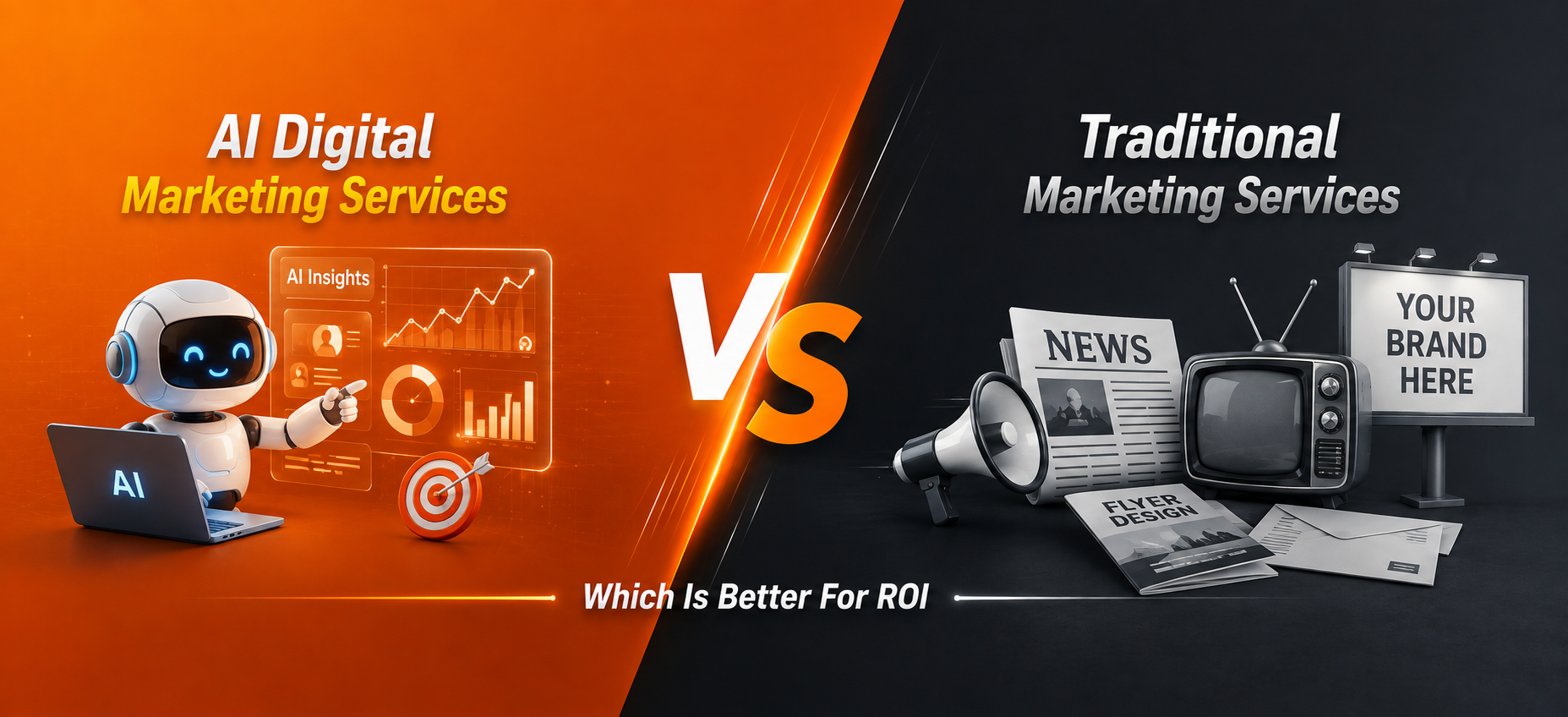
This is where ai digital marketing services come in. These services combine artificial intelligence, automation, data analysis, and human marketing expertise into a single approach designed to make campaigns faster, more precise, and easier to measure. But how does this compare to the traditional way of doing marketing, where strategy and execution are driven almost entirely by human judgment?
In this article, we’ll break down the real differences between AI-powered and traditional marketing across cost, speed, personalization, SEO, content, and social media, and most importantly, which approach tends to deliver better ROI. If you want a clearer picture of where your own marketing stands, we also offer a free marketing or SEO assessment to help identify potential growth opportunities before you commit budget to either direction.
Not Sure What’s Driving Your Marketing ROI?

 Chat on WhatsApp
What Are AI Digital Marketing Services
AI digital marketing services use machine learning, automation, data analysis, and predictive technology to support day-to-day marketing work. Instead of a team manually digging through spreadsheets and search data, AI tools process that information in a fraction of the time and surface patterns a person might miss.
Common applications include:
- Keyword research and search intent analysis
- Audience segmentation and behavioral analysis
- Content planning and topic discovery
- Personalization of ads, emails, and website experiences
- Campaign optimization based on real-time performance data
- Automated reporting and performance dashboards
An ai seo digital marketing agency typically blends these AI capabilities with technical SEO knowledge and content strategy, rather than relying on AI tools alone. The value isn’t just in the technology. It’s in how that technology is applied to a business’s specific goals. AI is exceptionally good at processing large volumes of information quickly and identifying patterns that would take a human analyst days or weeks to find manually.
What Makes Traditional Marketing Services Different

Traditional marketing depends far more on human research, creative strategy, hands-on campaign management, and manual reporting. There’s no algorithm doing the heavy lifting behind the scenes. It’s people making decisions at every stage.
In a traditional setup, SEO teams often perform keyword research, competitor analysis, and content planning by hand, drawing on experience rather than automated pattern recognition. This isn’t a weakness by default. Human marketers bring things AI still struggles to replicate:
- Deep industry knowledge and market context
- Brand voice and creative judgment
- Genuine customer insight built from direct conversations and experience
- The ability to read nuance in a way automated systems can’t
Traditional approaches tend to remain effective in situations that depend on strong personal relationships, negotiation, or highly specialized subject-matter expertise, where a human touch still outperforms automation.
Why Is ROI the Most Important Marketing Comparison
Cost is easy to compare. ROI is harder, and far more important. ROI connects what a business spends on marketing to measurable outcomes: revenue, leads, sales, and customer acquisition.
The metrics that actually matter here include:
- Conversion rate
- Customer acquisition cost (CAC)
- Return on ad spend (ROAS)
- Revenue per visitor
- Customer lifetime value (CLV)
Here’s the part many businesses miss: a lower marketing cost does not automatically mean a higher ROI. A campaign that costs more upfront can still deliver a far better return if it produces higher-quality leads and generates more revenue per dollar spent. This is why comparing AI and traditional marketing purely on price misses the point. The real comparison has to be based on outcomes.
How Do AI and Traditional Marketing Compare
| Factor | AI Digital Marketing | Traditional Marketing |
| Research | Faster and automated | More manual |
| Personalization | Highly scalable | More limited |
| Content Workflow | AI-assisted | Primarily human-led |
| Data Analysis | Fast processing | More manual analysis |
| Campaign Optimization | Frequent and data-driven | Often manually managed |
| Scalability | High | Depends on team capacity |
AI digital marketing services provide clear advantages in automation and processing speed. Campaigns can be adjusted in near real time based on performance data. Traditional marketing, on the other hand, provides stronger direct human involvement at every stage of the process.
It’s worth remembering that both approaches still require strategic planning and consistent performance measurement. Neither one runs on autopilot successfully without oversight. The best option ultimately depends on your business goals, available resources, industry, and target audience.
How Can AI Reduce Marketing Costs
Automation reduces the time spent on repetitive tasks: research, reporting, data analysis, and even parts of content production. A marketing team using AI tools can typically handle a larger workload without a proportional increase in manual hours.
Some of the ways this plays out in practice:
- AI tools can identify keyword and audience opportunities faster than manual research
- Automated reporting frees up hours previously spent building spreadsheets
- Predictive analysis can flag underperforming campaigns before they burn through budget
That said, AI isn’t free. Software subscriptions, staff training, system integration, and the human supervision needed to review AI output all add real costs. ROI should always be measured against the total marketing investment, meaning software, labor, and strategy combined, rather than the price of the AI tool alone.
Why Are AI SEO Services Becoming More Popular
Ai seo services are gaining traction because they can support keyword research, search intent analysis, competitor research, content optimization, and SEO reporting at a scale manual processes struggle to match.
AI can process large keyword and competitor datasets far faster than a person working through the same data by hand. This speed lets SEO professionals make strategic decisions sooner, rather than spending days compiling raw data before any real analysis can begin.
That said, AI isn’t a replacement for the fundamentals. Technical SEO, website user experience, authority building through backlinks and reputation, and quality control still require human expertise and judgment. Businesses should keep their attention on measurable outcomes, such as organic traffic, qualified leads, and revenue, rather than treating “using AI” as a goal in itself.
How Can an AI SEO Company Improve Search Performance
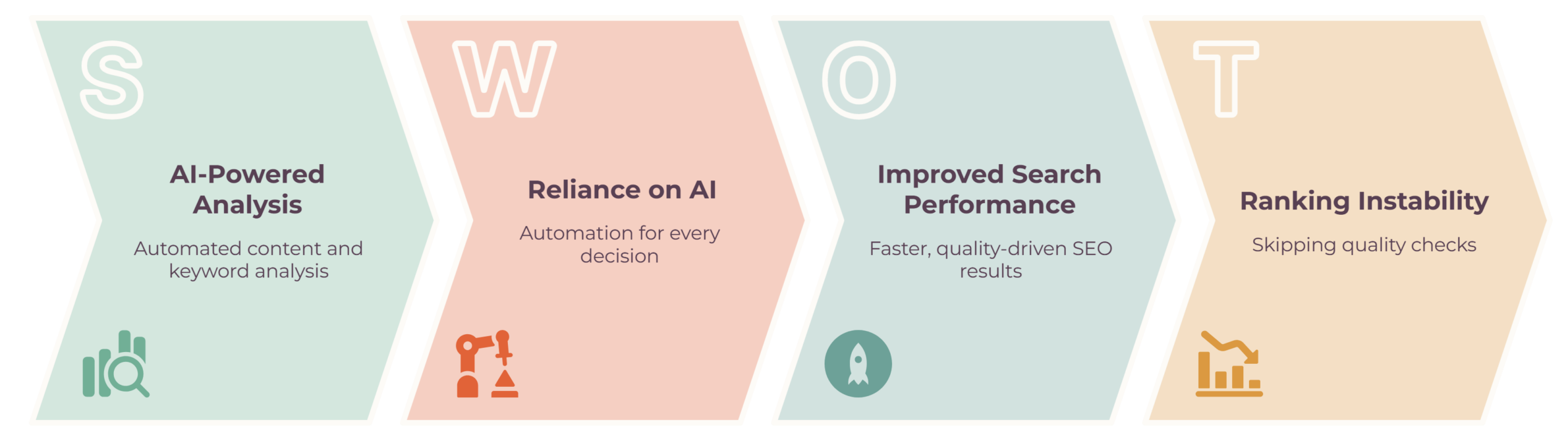
An ai seo company typically combines AI-powered analysis with technical SEO knowledge and content strategy, rather than relying on automation for every decision.
In practice, this usually looks like:
- Automated analysis identifying content gaps, keyword opportunities, and technical issues across a site
- AI helping prioritize which pages to fix or build first based on search potential and business value
- Human SEO specialists reviewing AI recommendations before anything goes live
- Ongoing performance tracking through rankings, organic traffic, conversions, and revenue
This combination allows an SEO team to move faster without skipping the quality checks that keep a website’s rankings stable and trustworthy over time.
What Should You Look for in an AI SEO Agency
Not every agency claiming to use AI is actually applying it well. When evaluating an ai seo agency, look for the following:
- A proven SEO process supported by AI, not AI tools used as the entire strategy
- Case studies showing measurable improvements in traffic, leads, conversions, or revenue
- Strong technical SEO, content, analytics, and strategy capabilities that exist independently of the AI tools being used
- Transparent reporting and clear communication about how and where AI is actually being applied
- A human review process for content, recommendations, and important SEO decisions before implementation
If an agency can’t clearly explain what the AI is doing and why, that’s usually a sign the strategy behind it is thin.
How Does AI Change Content Marketing
AI has meaningfully sped up the early stages of content production. Research, topic discovery, content briefs, outlines, and on-page optimization can all be accelerated significantly.
But there’s a limit to what automation alone can produce. A content marketing specialist adds things AI can’t generate on its own: industry experience, original insights, a consistent brand voice, and expert opinions that carry weight with readers.
Content marketing consulting plays a similar role at a strategic level, connecting content production to actual business goals and mapping it against the customer journey, rather than just producing articles for the sake of publishing volume. Human editing and fact-checking remain essential for maintaining accuracy, originality, and trust. At the end of the day, high-quality content needs to provide genuinely useful information, not just increase how much gets published.
How Can AI Improve Social Media Marketing
AI supports social media work in several practical ways: generating content ideas, analyzing audience behavior, scheduling posts, spotting emerging trends, and compiling performance reports.
A social media management agency can use these tools to handle repetitive operational tasks while keeping human oversight over the campaigns that actually represent the brand publicly. This division of labor tends to work well, with automation covering the routine work and people focusing on anything customer-facing or creative.
Social media marketing agencies can also use AI-driven audience insights to sharpen targeting and personalization, reaching the right segments with more relevant messaging. Still, human marketers remain essential for creative campaign concepts, community management, and handling sensitive customer interactions where tone and empathy matter. Ultimately, performance on social platforms should be tied to engagement, leads, conversions, and revenue, not just follower counts or impressions.
Why Does Human Expertise Still Matter in AI Marketing
AI is only as good as the information, data quality, and instructions it’s given. Feed it vague direction or poor data, and the output reflects that.
Human experts bring context AI doesn’t have on its own: brand positioning, customer emotions, industry-specific challenges, and business priorities that shift over time. Experienced marketers are also the ones who catch it when an AI recommendation is inaccurate or simply doesn’t fit the business.
Human oversight is what maintains originality, trust, regulatory compliance, and brand consistency across a marketing program. The strongest model isn’t AI replacing people. It’s AI efficiency paired with human decision-making at the points that matter most.
When Can Traditional Marketing Deliver Better ROI
Traditional marketing still holds an edge in specific situations:
- Campaigns that depend heavily on relationships, trust-building, and face-to-face interaction
- Specialized industries that require detailed human research and expert-led content, such as highly regulated fields or niche B2B markets
- Smaller businesses that may benefit from simple, manual strategies before investing in more complex AI systems
- Situations where poorly implemented AI risks producing low-quality content and wasted marketing spend
The core principle here is straightforward: the marketing method should match the business objective, not simply follow whatever technology trend is currently popular.
When Can AI Digital Marketing Deliver Better ROI
On the other side, AI digital marketing services tend to shine when a business is managing large volumes of data, content, customers, or campaigns at once.
AI-driven automation reduces repetitive work and improves operational efficiency across the board. It also helps teams identify trends and optimization opportunities faster than manual analysis would allow. Personalized marketing, powered by AI, can improve the relevance of campaigns even as they scale to larger audiences.
Ai digital marketing services become especially valuable when a business needs to grow without adding headcount at the same rate, essentially doing more with the same team by removing manual bottlenecks.
Which Is Better for SEO: AI or Traditional Marketing
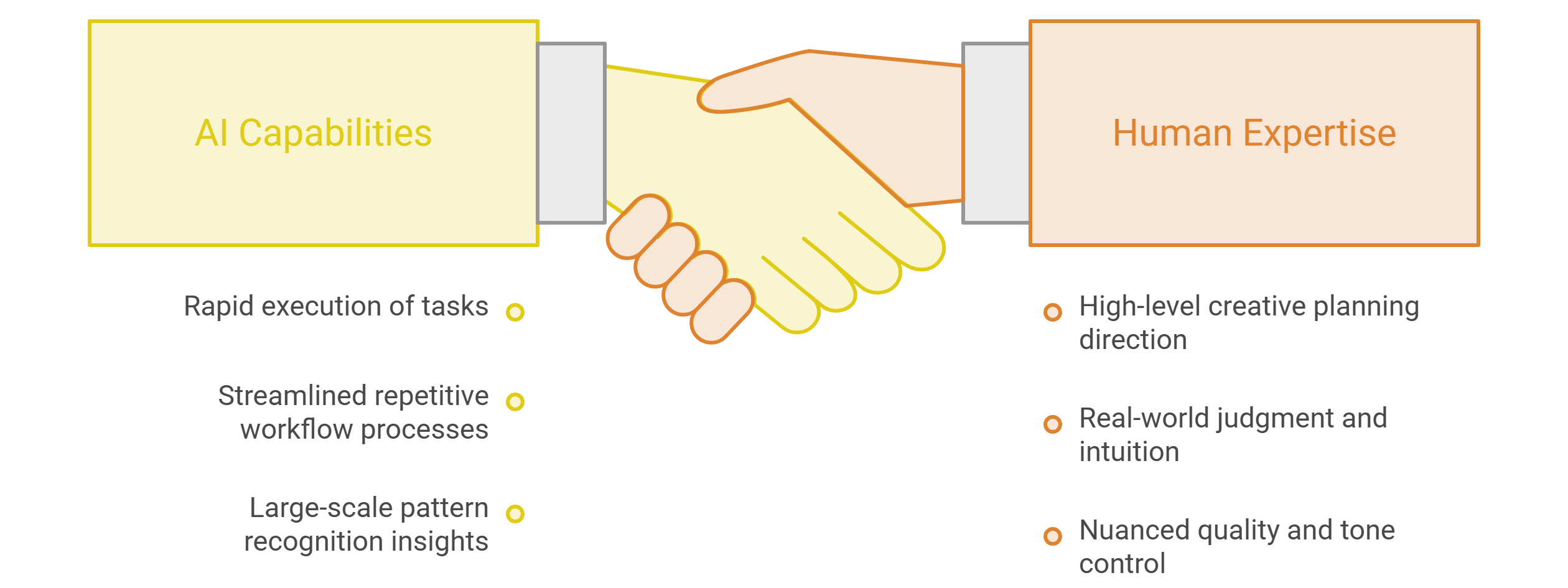
The honest answer is that both bring something different to the table.
AI provides speed, automation, large-scale analysis, and faster identification of SEO opportunities across a website or content library. Traditional SEO provides human strategy, real-world experience, technical judgment, and content expertise that’s harder to automate.
AI-generated recommendations should always be reviewed by experienced SEO professionals before implementation. This is where a hybrid SEO strategy tends to outperform either extreme, combining automated analysis with human decision-making at the critical steps. Ultimately, the better option is whichever one produces sustainable rankings, qualified traffic, leads, and revenue over time, not whichever sounds more advanced on paper.
What Are the Biggest Mistakes Businesses Make With AI Marketing?
Some of the most common and costly mistakes include:
- Publishing large volumes of low-quality or repetitive content
just because AI makes it fast to produce - Choosing an ai seo consultancy based only on claims about AI technology, without checking actual results
- Assuming AI can completely replace experienced marketers,
rather than working alongside them - Measuring impressions and clicks instead of leads, sales, and revenue,
metrics that don’t reflect real business impact - Publishing AI-generated information without proper fact-checking and expert review, which risks accuracy and brand trust
Avoiding these mistakes usually comes down to one thing: treating AI as a tool that supports strategy, not a replacement for it.
How Can Businesses Choose the Right Marketing Model
Choosing between AI, traditional, or hybrid marketing doesn’t have to be a guessing game. A practical process looks like this:
- Start with the main objective,
whether that’s leads, sales, organic traffic, customer retention, or brand awareness - Compare your current marketing team’s workload, skills, budget, and technology against what each approach requires
- Identify repetitive tasks that can safely be automated
without sacrificing quality or accuracy - Test AI-assisted campaigns against your existing marketing processes
on a smaller scale before committing fully - Choose between AI, traditional, or hybrid marketing based on measurable performance, not assumptions
This step-by-step approach reduces the risk of switching models based on hype rather than actual fit.
Which Marketing Approach Offers the Best ROI
There isn’t a single universal answer. It depends on the business. AI can provide clear advantages in speed, scalability, personalization, automation, and data analysis. Traditional marketing remains valuable for creativity, strategy, relationships, and expert judgment.
A hybrid model, in most cases, combines the strengths of both approaches rather than forcing a choice between them. The best ai seo agency or marketing partner will focus on business outcomes, not simply on how much AI they use. In the end, ROI should be the deciding factor in choosing the right marketing approach, not preference for one method over the other.
Conclusion: Which Marketing Strategy Should You Choose
AI offers real advantages in automation, speed, data analysis, personalization, and scalability, benefits that are hard to ignore for businesses managing growing volumes of data, customers, and content. At the same time, traditional marketing remains important for strategy, creativity, relationships, and the kind of expert decision making that automation still cannot fully replicate.
For most businesses, the strongest approach combines AI technology with experienced marketing professionals rather than choosing one over the other entirely. When comparing your options, base the decision on revenue, conversions, customer acquisition cost, and long term growth, not simply on which approach sounds more modern.
At Redefining Web, we combine data driven digital marketing strategies with human expertise to help businesses identify growth opportunities, improve search visibility, and achieve measurable results. If you are not sure where your current marketing stands, our team can provide a customized marketing assessment to identify where AI can improve your ROI and where a traditional or hybrid approach may deliver better results.
Get Your Free Marketing Assessment
FAQs About AI Digital Marketing Services and ROI


Know your website’s SEO Score.
Get a customized SEO Audit report & improve your website statistics.