
Search behavior shifted fast, and strategies that worked two years ago are quietly losing traffic for e-commerce stores. AI-generated summaries, zero-click results, and conversational search have changed what ranking even means. Most stores still run outdated SEO; zero-click search engines have already moved on. Working with the right e-commerce SEO company means building a strategy for where search is headed, not where it used to be. This article breaks down what that strategy looks like in 2026.
Want a clear picture of where your store stands?

 Chat on WhatsApp
How Search Behavior Has Changed for Ecommerce Shoppers in 2026
Shoppers no longer type short keyword strings into a search bar and scroll through ten blue links. They ask full questions, expect direct answers, and often get those answers from AI-generated summaries before they click a single site. Zero-click searches now answer basic product questions right on the results page, which means stores lose visibility if their content only targets old-style keyword phrases.
Conversational queries dominate voice search and AI chat tools alike. A shopper might ask, “Which running shoes work best for flat feet under 100 dollars?” Instead of typing “running shoes for flat feet.” Stores that fail to write content matching this natural phrasing miss a growing share of search traffic, even if their technical SEO looks solid on paper.
5 Signs Your Ecommerce SEO Strategy Is Stuck in the Past
Many stores hold onto habits that made sense years ago but hurt rankings now. Here are five signs a strategy needs an update:
- Product pages stuffed with repeated keywords instead of natural language
- No structured data or schema markup on product and category pages
- Zero visibility in AI search tools like ChatGPT or Google’s AI Overviews
- Content formats stuck in plain text blocks with no video, comparison charts, or visual aids
- Missing mobile-first optimization despite most traffic coming from phones
If two or more of these sound familiar, the store’s SEO foundation needs rebuilding rather than small tweaks.
Why Working With the Best SEO Agencies Means Rethinking Strategy Entirely
The best SEO agencies no longer treat SEO as a checklist of keywords and backlinks. They build strategy around search intent first, asking what the shopper actually wants to accomplish rather than which words they typed. Teams like Redefining Web have shaped this shift by pairing technical fixes with content built for how people actually search, rather than treating the two as separate projects.
AI search readiness has become a core part of agency work too. Instead of a static plan built once a year, top agencies run ongoing testing, adjusting content and technical elements as algorithms and AI models change. A strategy that stays fixed for twelve months will fall behind stores that adapt every month.
Why an Ecommerce SEO Audit Should Be the First Step, Not an Afterthought
Skipping an e-commerce SEO audit and jumping straight into content or backlink work is like renovating a house without checking the foundation first. An audit identifies technical issues, content gaps, and competitor advantages before a single dollar gets spent on execution. Without this step, stores often fix problems that were never hurting rankings while ignoring the ones that were.
Competitor benchmarking during an audit also shows where a store stands against others in its niche. This context matters because SEO decisions made in isolation, without knowing what competitors already rank for, tend to waste time chasing keywords that are already locked up by stronger domains.
What a Thorough Ecommerce SEO Audit Actually Uncovers
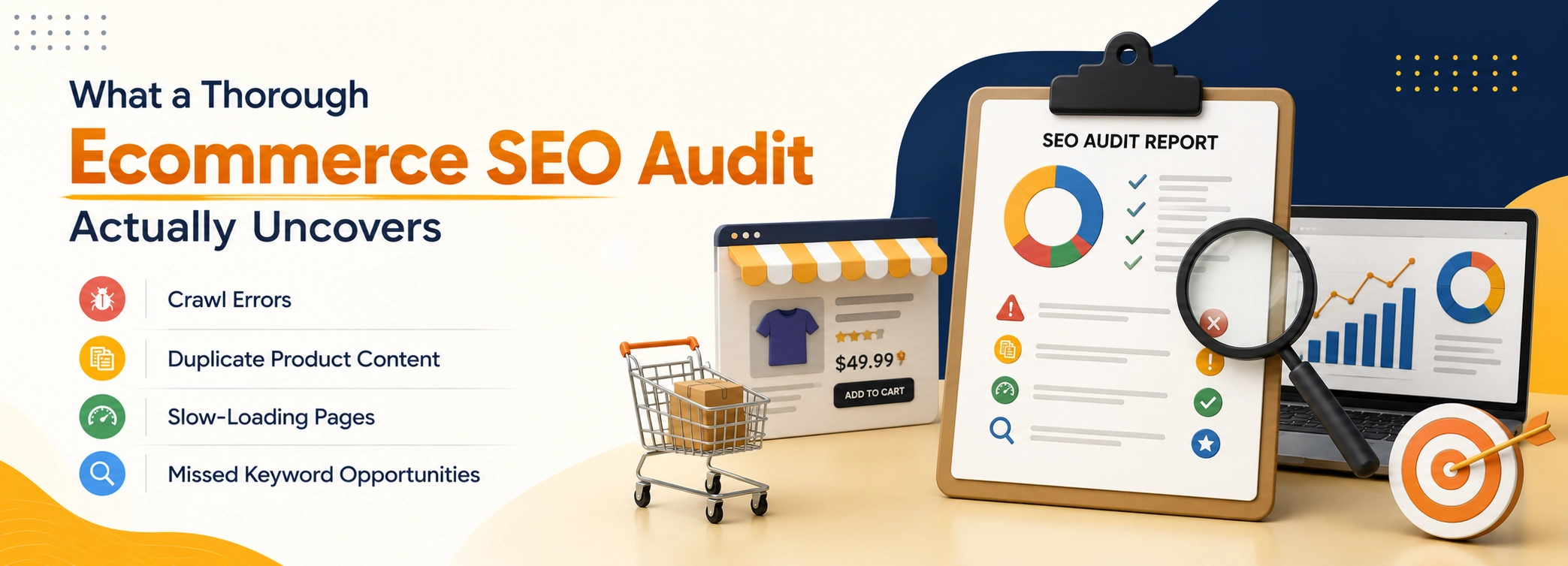
A proper audit digs past surface-level metrics and finds the issues actually costing a store traffic and sales. Crawl errors often hide broken internal links or pages search engines cannot reach at all. Duplicate product content, common on stores with similar variants, confuses search engines about which page deserves ranking priority.
Slow loading pages push shoppers away before they even see a product, and search engines notice that bounce behavior too. Missed keyword opportunities round out the list, revealing search terms competitors rank for that the store has never targeted. Each of these findings becomes a specific fix rather than a vague suggestion.
How an Ecommerce SEO Consultant Turns Audit Findings Into Action
An audit report full of findings means little without a plan to act on it. A skilled e-commerce SEO consultant takes that list and prioritizes fixes based on sales impact rather than fixing everything at once in random order. A slow product page that gets thousands of visits monthly deserves attention before a rarely viewed page with the same loading issue.
Building a realistic timeline matters just as much as prioritization. Some fixes take a day, others take months, and a consultant maps out which comes first based on effort and expected return. Aligning every fix with actual business goals, whether that means more revenue, more email signups, or more repeat customers, keeps the whole process focused instead of scattered.
Comparison Table: DIY SEO Audit vs Professional Ecommerce SEO Audit
| Factor | DIY Audit | Professional Audit |
| Accuracy | Often misses technical issues | Catches issues most owners overlook |
| Time investment | Weeks of trial and error | Days, with clear findings |
| Depth of technical review | Surface-level checks | Full crawl, schema, and speed analysis |
| Actionable insights | General suggestions | Specific, prioritized fixes |
| Cost | Free but time-heavy | Paid but faster and more precise |
Why SEO Content Writing Services Matter More Than Ever in 2026
Content now needs to work for two audiences at once. SEO content writing services built for 2026 write copy that satisfies AI summaries and human readers in the same piece. That means answering the core question clearly near the top of the page instead of burying it under paragraphs of introduction.
Generic AI-sounding content, the kind that reads like it was generated in bulk with no real voice, tends to underperform even when it hits the right keywords. Search engines increasingly reward content that answers intent directly and reads like it was written by someone who actually understands the product or industry.
What the Best Content Writing Services Do Differently for Ecommerce
The best content writing services treat product descriptions as more than a list of specs. They write copy that helps a shopper decide to buy while also giving search engines the language and structure needed to rank the page. A generic description copied from a manufacturer rarely does either job well.
Category page content gets similar attention, framing the page around what a shopper wants to compare or learn before choosing a product. Buyer-focused FAQ content rounds out this approach, answering the exact questions shoppers type into search bars or ask AI assistants directly on the product or category page itself.
How a Website Content Writing Service Supports Long-Term Ecommerce Growth
A single round of content rarely produces lasting results. A website content writing service built for e-commerce works on a consistent publishing cadence, adding new pages and articles on a schedule rather than in occasional bursts. Search engines tend to favor sites that show steady, ongoing activity over ones that publish everything at once and go quiet.
Content also needs mapping to funnel stages, from early research content that answers broad questions to bottom funnel pages that compare specific products. Refreshing older content matters just as much as creating new pages, since outdated statistics or discontinued products can quietly drag down pages that once ranked well.
6 Content Types E-commerce Stores’ Needs for 2026 Search Visibility
Stores that want strong visibility across traditional search and AI search need a mix of content formats, not just product pages:
- Optimized product pages written for both conversion and search intent
- Buying guides that walk shoppers through decisions before purchase
- Comparison content that pits products or brands against each other
- FAQ blocks answering common pre-purchase questions directly
- Video-supported content that boosts engagement and dwell time
- Customer story content that builds trust through real experiences
What Sets Ecommerce SEO Agencies Apart From General SEO Firms
Not every SEO firm understands the specific mechanics of running an online store. E-commerce SEO agencies bring platform-specific knowledge, whether that means Shopify, WooCommerce, or a custom-built storefront, and they know how each platform handles technical SEO differently. General firms often apply the same playbook regardless of platform, which leads to missed opportunities.
Conversion understanding also separates e-commerce specialists from general firms. Ranking a page means little if it fails to turn visitors into buyers, so e-commerce-focused agencies build strategy around product-focused keyword research that reflects actual purchase intent rather than broad informational searches.
How to Evaluate an SEO Agency for Ecommerce Before Hiring
Choosing the right SEO agency for e-commerce requires more than reading a few testimonials. Past results with stores in a similar niche or on a similar platform give a much clearer picture than generic case studies. Reporting transparency matters too, since an agency that hides behind vague monthly summaries makes it hard to judge real progress.
Understanding of AI search trends has become a deciding factor for many stores in 2026. An agency still focused only on traditional blue link rankings misses a growing share of where shoppers actually find products now. Asking direct questions about AI search strategy during the hiring process reveals a lot about how current an agency’s approach really is.
What Quality SEO Consultant Services Should Include in 2026
Not all SEO consultant services offer the same depth of support. A personalized strategy built around a store’s specific products, audience, and goals should always come before any generic template. Ongoing performance reviews matter just as much, since a strategy that never gets revisited tends to grow stale within a few months.
Clear communication and reporting round out what quality service should look like. A consultant who explains findings in plain language, without hiding behind jargon, makes it easier for store owners to make informed decisions about where to invest next.
Why the Best SEO Agencies Combine Technical, Content, and AI Search Strategy
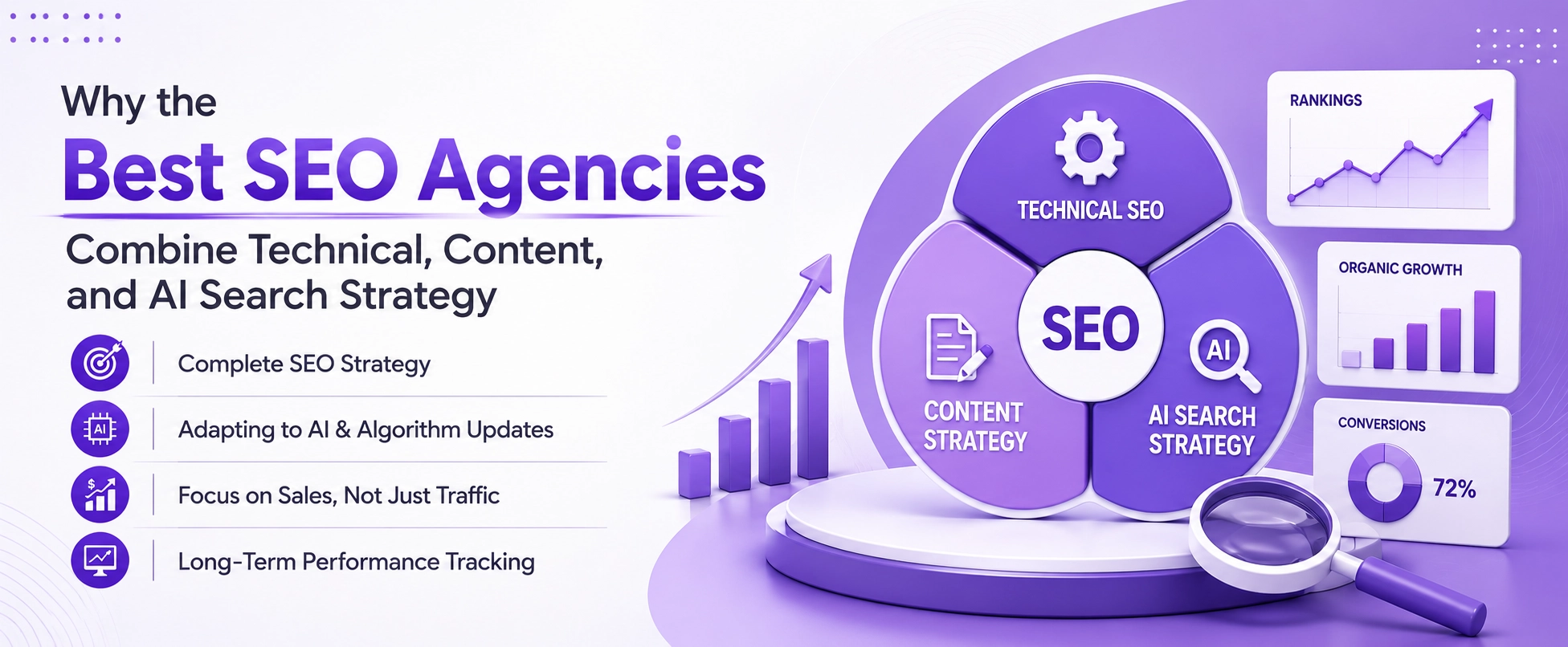
A coordinated approach beats piecemeal fixes every time. The e-commerce SEO company that only fixes technical issues without addressing content or writes content without fixing technical problems leaves real ranking potential on the table. Combining both under one strategy produces results that compound over time.
Adapting to algorithm and AI search updates also separates strong agencies from average ones. Search engines change their ranking signals constantly, and AI search tools evolve even faster. Measuring results against actual sales, not just raw traffic numbers, keeps the whole strategy tied to business outcomes rather than vanity metrics.
Comparison Table: General SEO Agency vs Specialized Ecommerce SEO Agency
| Factor | General SEO Agency | Specialized Ecommerce SEO Agency |
| Platform expertise | Limited or generic | Deep knowledge of e-commerce platforms |
| Conversion focus | Rarely prioritized | Built into strategy from the start |
| Content strategy depth | Broad, not product-focused | Tailored to product and category pages |
| Reporting relevance | Traffic focused | Sales- and revenue-focused |
| Long-term ROI | Inconsistent | Stronger due to niche focus |
How to Future-Proof Ecommerce SEO Against Ongoing Search Changes
Search will keep changing, so strategy needs to focus on signals that hold value regardless of the next algorithm update. Trust and authority signals, built through genuine reviews, credible backlinks, and transparent business information, tend to survive most search changes. Structured data adoption also protects a store, since it helps search engines and AI tools understand product information accurately no matter how the interface changes.
Monitoring AI search visibility has become a new but necessary habit. Stores that check how often they appear in AI-generated answers, not just traditional search rankings, catch visibility problems before they turn into major traffic drops.
5 Questions to Ask an Ecommerce SEO Company Before Signing On
Before committing to any agency or consultant, a few direct questions can save months of wasted spend:
- Do you have experience with our specific e-commerce platform?
- How do you approach AI search trends and visibility?
- Does your service include content strategy or only technical work?
- What does your audit process look like before we start?
- How often will we receive updates and reporting?
Clear answers to these questions reveal whether an agency actually fits a store’s needs or simply offers a generic package.
Why Consistency Matters More Than Quick Fixes in 2026 SEO
Quick fixes and short-term ranking tactics tend to produce short-term results that fade fast. Consistent optimization, applied month after month, compounds in a way that one-time fixes never do. Stores chasing fast wins often find themselves back at square one within a year.
Building sustainable organic growth takes patience, but it produces results that hold up even when algorithms shift. A store that invests in steady, ongoing SEO work rarely faces the sharp traffic drops that hit stores relying only on short-lived tactics.
How to Measure If Your Ecommerce SEO Strategy Is Actually Working in 2026
Raw traffic numbers tell an incomplete story on their own. Organic conversion rate matters more than total visitors, since a smaller amount of highly targeted traffic often produces more sales than a large amount of unqualified clicks. Visibility in AI-generated search results has become another key metric, showing whether a store appears in the tools shoppers increasingly rely on for quick answers.
Customer acquisition cost from organic search rounds out the picture. A strategy that lowers this cost over time, while maintaining or growing sales, proves its value far better than ranking reports alone ever could.
Closing Thoughts
Ecommerce SEO in 2026 requires audits, content strategy, and platform expertise working together instead of outdated tactics applied in isolation. The right e-commerce SEO company builds strategy around where search is headed, not where it used to be. Agencies such as Redefining Web have documented this shift in their own client work, showing how audits, content, and AI search readiness combine into results that hold up over time.
Get a free e-commerce SEO strategy consultation or request a custom quote today.
Frequently Asked Questions About E-commerce SEO Company


Know your website’s SEO Score.
Get a customized SEO Audit report & improve your website statistics.