Skip to main content



You found a great agency. You reviewed the proposal. Now you stare at a contract page that says 12 months, and something in your gut tightens.
That reaction makes sense. An SEO agency relationship is not a trial subscription you cancel after a free month. It is a financial commitment with a timeline attached, and the length of that contract will shape how the work gets done, how fast you see results, and what leverage you have if things go sideways.
Most business owners want a straight answer: how long should this take? The honest answer is that it depends on your site, your industry, your competition, and what the agency actually plans to do with your money. This article breaks each of those variables down so you can walk into that contract conversation with full clarity.
Ready to find the right SEO contract for your business?

 Chat on WhatsApp
Why SEO Contracts Exist in the First Place
SEO is not a switch you flip. Google needs time to crawl your site, process new content, evaluate your backlinks, and decide where you belong in search results. That process takes months, not days.
Agencies set minimum contract windows because the work requires serious upfront investment. A proper technical audit, keyword research, content strategy, and competitor analysis all happen before a single page ranks. Without a committed window, an agency absorbs that cost with no guarantee of continued work. That is a bad deal for them, and it often leads to shallow work.
For you as the client, a contract creates structure. It locks in your monthly rate, defines what the agency delivers each month, and gives both sides a shared definition of success. A vague retainer with no contract is how budgets disappear without results.
How Long Are Most SEO Contracts
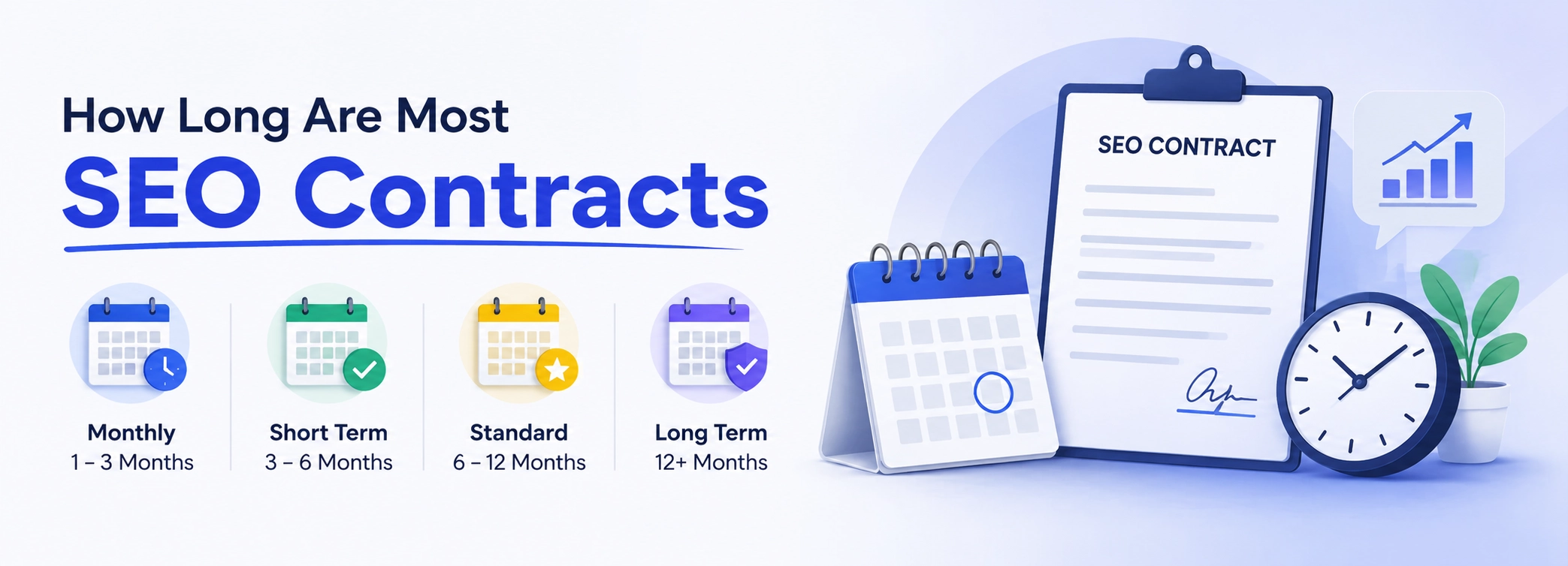
Most agencies structure contracts into four main categories. Here is what each one looks like in practice:
| Contract Type | Typical Length | Best For |
| Month-to-Month | Rolling 30 days | Businesses are testing a new agency |
| Short-Term | 3 to 6 months | Targeted campaigns or audits |
| Standard | 6 to 12 months | Most small to mid-size businesses |
| Long-Term | 12 to 24 months | Competitive industries and enterprise clients |
The sweet spot for most businesses sits between 6 and 12 months. That window gives the agency enough runway to complete a full audit, build content, earn backlinks, and measure ranking shifts across at least one or two algorithm updates.
Month-to-month contracts exist, but they cost more per month and deliver less strategy. Agencies price them higher to offset churn risk, and they tend to focus on quick wins rather than long-term architecture. If you want real organic growth, a rolling 30-day arrangement rarely gets you there.
What Factors Determine Contract Length for Search Engine Optimization Services?
Several variables push contract length up or down. None of them is arbitrary.
-
Industry Competition
A local plumber targeting three suburbs needs far less time than a SaaS company competing against funded startups with massive content teams. Competitive industries require more content, more links, and more time before rankings shift. Agencies in those spaces almost always push for 12 months minimum, and they have good reason to. -
Your Site’s Current Condition
A site with no backlinks, slow load speed, duplicate content, and thin pages needs a longer runway. A site that already ranks for some terms and has clean technical health will move faster. The agency’s audit in month one tells you exactly where you stand. -
What You Actually Want to Achieve
Ranking for a handful of local service terms is a different challenge than ranking for competitive national keywords. Narrow, specific goals produce results faster. Broad visibility campaigns in crowded categories take longer and cost more. -
Monthly Budget
More budget means more content, more outreach, and more technical work per month. That compresses the timeline. A smaller monthly spend spreads the same scope across more months. Neither approach is wrong, but you need to match your budget to your timeline expectations. - Google’s Update Schedule
Google pushes core algorithm updates several times per year. Some of them shuffle rankings significantly. Agencies build buffer time into contracts to account for recovery periods after major updates. A 12-month contract almost always spans at least two or three update cycles, which gives the agency time to adapt.
Breaking Down the 12-Month Standard for Local SEO Strategies
Twelve months became the industry standard because it reflects how organic search actually works. Here is what a well-run 12-month campaign looks like month by month.
-
Months 1 to 2: Foundation Work
The agency audits your site, fixes crawl errors, resolves technical issues, improves page speed, and sets up proper tracking. Nothing ranks yet. That is normal. This phase builds the base that everything else sits on. Skip it, and you build on sand. -
Months 3 to 4: Content and Keyword Buildout
Content production starts. The agency targets priority keywords, fills gaps in your existing content, and optimizes pages that already have some traction. Early ranking movement appears here, mostly on lower-competition terms. These early wins validate the strategy and build momentum. -
Months 5 to 6: Authority Building
Link acquisition ramps up. Guest posts, digital PR placements, and editorial links start pointing to your site. Domain authority rises gradually. Rankings stabilize and start climbing more consistently across your core keyword targets. -
Months 7 to 9: Compounding Growth
This is where the investment starts to pay off visibly. Content and links work together to push pages into positions that generate real traffic. You start capturing clicks from terms that were out of reach three months earlier. Monthly traffic reports start showing numbers worth discussing. - Months 10 to 12: Measurement and Optimization
The agency reviews what performed, doubles down on high-traffic pages, prunes what did not work, and builds a roadmap for the next phase. Renewal conversations happen here. If the relationship is working, most clients extend without hesitation.
Clients who exit at month three paid for the foundation and walked away before the house went up. That is one of the most common and most expensive mistakes in search engine optimization services
Red Flags in SEO Contracts
Some contracts are not structured to protect you. These are the warning signs worth checking before you sign anything.
-
Guaranteed ranking promises: Google does not let agencies reserve positions. Any contract that guarantees a specific rank is either dishonest or naive.
-
Vague deliverables: Language like “ongoing optimization” with no specifics gives you no basis for accountability. Every deliverable should be named, quantified, and dated.
-
Auto-renewal traps: Some contracts roll into another full year unless you cancel 60 or 90 days before the end date. Read the renewal clause carefully.
-
Ownership gaps: Every piece of content, every report, every asset the agency creates should belong to you. Some agencies claim ownership and take their work with them when the contract ends.
-
No reporting structure: Monthly reports with clear KPIs are standard. If the contract does not specify what gets reported and when, add it before you sign.
- Heavy exit fees: Early termination fees are common, but they should be reasonable. A penalty that equals three months of retainer cost for leaving one month early is not reasonable.
Short-Term vs Long-Term: Which One Fits Your Business?
Short-Term Contracts (3 to 6 Months)
Short contracts work well for narrow, defined projects. A technical audit. A content sprint ahead of a product launch. A local citation cleanup. When the goal is specific and the deliverable is clear, a short contract makes sense.
They also work as a low-risk test. You get to evaluate the agency’s communication style, work quality, and reporting before committing to a full year. Many businesses use a six-month engagement to vet an agency before renewing on longer terms.
The limitation is real. Three to six months does not give organic search ranking enough time to compound. Rankings are still stabilizing when the contract ends. Agencies under short-term pressure also tend to chase quick wins rather than build sustainable architecture.
Long-Term Contracts (12 to 24 Months)
Long-term contracts suit businesses that treat organic search as a primary growth channel. They give the agency space to build authority, test content formats, recover from algorithm shifts, and optimize based on real performance data rather than guesses.
The risk is locking into a relationship that underperforms. That is why agency vetting matters more than contract length. A 12-month contract with the wrong agency costs twice what a 6-month contract with the right one does.
Comparing SEO Contract Structures: What You Actually Get
Before you sign, see how different contract lengths compare across the things that actually matter.
| Feature | Month-to-Month | 3 to 6 Months | 6 to 12 Months | 12 to 24 Months |
| Monthly Pricing | Highest | High | Standard | Lowest per month |
| Technical Audit | Basic | Standard | Full | Full + Ongoing |
| Content Production | Minimal | Moderate | Consistent | High Volume |
| Link Building | Limited | Some outreach | Regular cadence | Aggressive buildout |
| Keyword Tracking | Basic | Standard | Advanced | Advanced + Historical |
| Reporting Frequency | Monthly | Monthly | Monthly + Quarterly | Monthly + Quarterly |
| Strategy Depth | Surface level | Moderate | Comprehensive | Enterprise-grade |
| AI SEO Integration | Rarely included | Sometimes | Usually included | Always included |
| Exit Flexibility | High | Moderate | Low | Very Low |
| ROI Potential | Low | Moderate | High | Highest |
| Best For | Trial run | Specific campaigns | Growing businesses | Competitive markets |
The pattern is consistent. Longer contracts cost less per month, deliver more strategic depth, and produce higher returns. Month-to-month flexibility comes at a real price, both in dollars and in results. For most businesses, the 6 to 12 month range offers the best balance between commitment and return on investment.
How AI SEO Services and AI SEO Consultancy Are Reshaping Contract Timelines
Agencies that use artificial intelligence now operate at a fundamentally different speed than those that do not. AI SEO services handle keyword clustering, content gap analysis, competitor research, and technical audits in a fraction of the time manual processes require. That speed changes how agencies structure contracts and what they promise within each phase.
An AI SEO company uses predictive models to forecast traffic growth based on domain authority, keyword difficulty, and historical ranking data. Those forecasts give clients a clearer picture of what to expect at month 3, month 6, and month 12. Better forecasting means less guesswork in contract negotiations and more realistic milestone setting from day one.
The AI SEO audit has also compressed the traditional contract entry point. A full technical audit is used to consume the first four to six weeks of a campaign. AI-powered tools now surface crawl errors, content gaps, backlink risks, and Core Web Vitals issues within days. Agencies reach active optimization faster, which benefits clients on shorter contracts who need early results to justify renewal.
An AI SEO service provider often structures contracts around performance milestones rather than fixed calendar dates. Because AI tools produce accurate traffic and ranking projections, some agencies tie renewal decisions to benchmark achievement rather than arbitrary end dates. That model aligns what the agency earns with what the client actually receives.
The best AI SEO agencies are transparent about which tools they use and how human strategists oversee the outputs. AI without human judgment produces content that misses context, audits that ignore business nuance, and links that do not match brand positioning. The technology accelerates execution. The strategist decides what to execute.
How to Evaluate the Best AI SEO Agency for Your Contract
The agency you choose shapes everything. Here is how to evaluate one before you commit.
-
Relevant Case Studies
Ask for results from clients in your industry or at a similar revenue stage. An agency that ranks e-commerce stores well may have no idea how to approach a professional services firm. Specificity matters more than volume of case studies. -
Reporting Transparency
Strong agencies connect monthly deliverables to measurable outcomes. They tell you what they did, what moved, and why. Weak agencies produce dense reports full of impressions and crawl stats without explaining what any of it means for your business. -
AI Tool Integration
The best AI SEO agency for your business will explain exactly which tools they use, how those tools integrate into strategy, and where human review sits in the process. Agencies that use AI to replace strategy rather than support it produce shallow work fast. -
Account Team Structure
Find out who works on your account after the pitch call. Senior strategists often hand accounts to junior teams after signing. Ask for names, roles, and monthly time allocation before you commit. -
Quarterly Review Points
Even inside a 12-month contract, strong agencies build in formal review checkpoints every three months. These allow strategy recalibration, deliverable adjustment, and early identification of underperformance before it becomes a bigger problem.
What Makes AI SEO Agencies Different From Traditional Ones
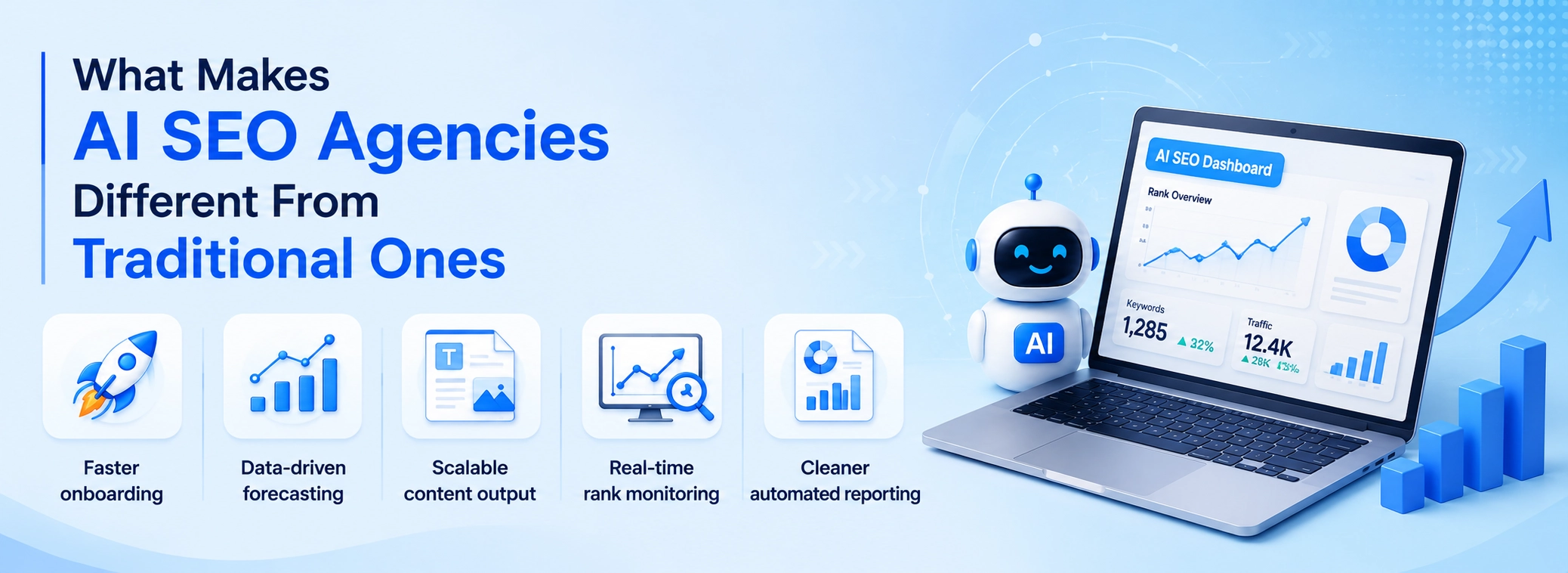
Genuine AI SEO agencies operate differently at every stage of the contract. Here is where those differences show up most clearly.
-
Faster onboarding: AI-driven audits and keyword research compress the setup phase from weeks to days, so clients see strategic output earlier in the contract.
-
Data-driven forecasting. AI models analyze competitor trajectories and content performance data to produce traffic projections that inform contract scope and length before work begins.
-
Scalable content output: AI-assisted workflows let agencies produce more optimized content within the same budget, which matters most for clients on shorter timelines who need faster results.
-
Real-time rank monitoring: Traditional agencies check rankings weekly or monthly. AI platforms track position changes and competitor moves in real time, allowing faster strategy pivots when algorithm shifts occur.
- Cleaner automated reporting: Clients receive faster and more granular reports because AI tools pull and organize performance data automatically rather than through manual spreadsheet work.
Understanding these differences helps you ask sharper questions during agency selection and set more accurate expectations for what a 6-month or 12-month contract should deliver.
What Happens After the Contract Ends
The contract end date arrives. Now what?
-
Renewal Offers
Most agencies present a renewal at the same or adjusted monthly rate. If results have been strong, this decision is straightforward. If results have been mixed, renewal is your opportunity to renegotiate deliverables, change the content focus, or push for better accountability terms. -
Month-to-Month Transition
Many clients roll into a month-to-month arrangement after a long-term contract concludes. Agencies usually accept this for established clients because onboarding costs are already absorbed, and the relationship is running smoothly. -
Switching Agencies
Before the contract ends, secure full access to your Google Search Console, Google Analytics, and all content and backlink reports. Some agencies slow-walk access transfers. Get everything in hand before the final invoice clears. - Sustaining the Gains
Organic search ranking results do not hold themselves. A site that stops receiving SEO investment gradually loses positions as competitors continue to publish content and earn links. Redefining Web has helped businesses across competitive industries maintain and grow those ranking gains through structured post-contract retainers built around long-term organic traffic growth.
Questions to Ask Before You Sign
Get direct answers to these before committing.
- What specific deliverables does each month include, and how do you track them?
- Who on your team works on my account, and how much time do they allocate monthly?
- Who owns the content, reports, and assets created during the contract?
- What are the early termination terms?
- How do you adjust strategy after a Google core update?
- What do results look like at month 6 versus month 12?
- Do you have case studies from businesses in my industry?
- Which AI SEO tools do you use, and how does human strategy oversight work?
- Does your team include a dedicated AI SEO consultancy function?
Agencies that answer these questions clearly and specifically are worth trusting. Agencies that deflect or stay vague are telling you something important.
Conclusion
The contract length is not the deciding factor. The agency is behind it. A 12-month contract with a focused, transparent SEO agency outperforms a 24-month contract with one that reports noise and deflects accountability. The right agreement defines what success looks like before work starts and includes clear terms for what happens if it does not.
Redefining Web has helped businesses navigate these decisions by building structured SEO engagements backed by the latest AI SEO service capabilities, aligning contract timelines with realistic organic traffic growth targets rather than overpromising speed or guaranteeing positions that no agency controls. Read the exit terms, confirm the deliverables, and choose a partner who treats your budget as an investment with a return.
Based in the US or UK and looking for a results-driven SEO partner?
Frequently Asked Questions About SEO Agency


Know your website’s SEO Score.
Get a customized SEO Audit report & improve your website statistics.