Skip to main content




Two names keep popping up in every SEO group chat and marketing forum right now. Business owners want rankings, and they keep hearing that Surfer SEO vs. Ahrefs is the decision that will make or break their content strategy. The truth sits somewhere quieter than the hype. These platforms solve different problems, and picking the wrong one wastes both budget and time. This article breaks down what each tool actually does, where they overlap, and why a human expert still matters more than any software subscription.
What Surfer SEO Is Built For
Surfer SEO focuses on content optimization and on-page scoring. Writers open the editor, type a target keyword, and watch a live score change as they add headers, terms, and structure. The tool pulls data from top-ranking pages and suggests word counts, related terms, and formatting patterns that match what already ranks.
This makes Surfer a favorite among content teams who need fast, structured guidance. The content editor was built with writers in mind, not developers or link builders. Someone who writes blog posts every day can open Surfer, follow the prompts, and produce a page that hits the technical marks a search engine wants to see.
What Ahrefs Is Built For
Ahrefs takes a different path. It centers on backlink analysis and full site audits. Marketers use it to track who links to a domain, spot toxic links, and monitor overall site health through crawl reports.
Beyond links, Ahrefs handles keyword research and competitor tracking at a deep level. Teams can see what keywords a rival ranks for, how much traffic those pages pull, and where gaps exist in their own content library. Technical SEO and site health monitoring round out the toolset, giving Ahrefs a broader reach than a pure content editor.
5 Signs You Need Surfer SEO More Than Ahrefs
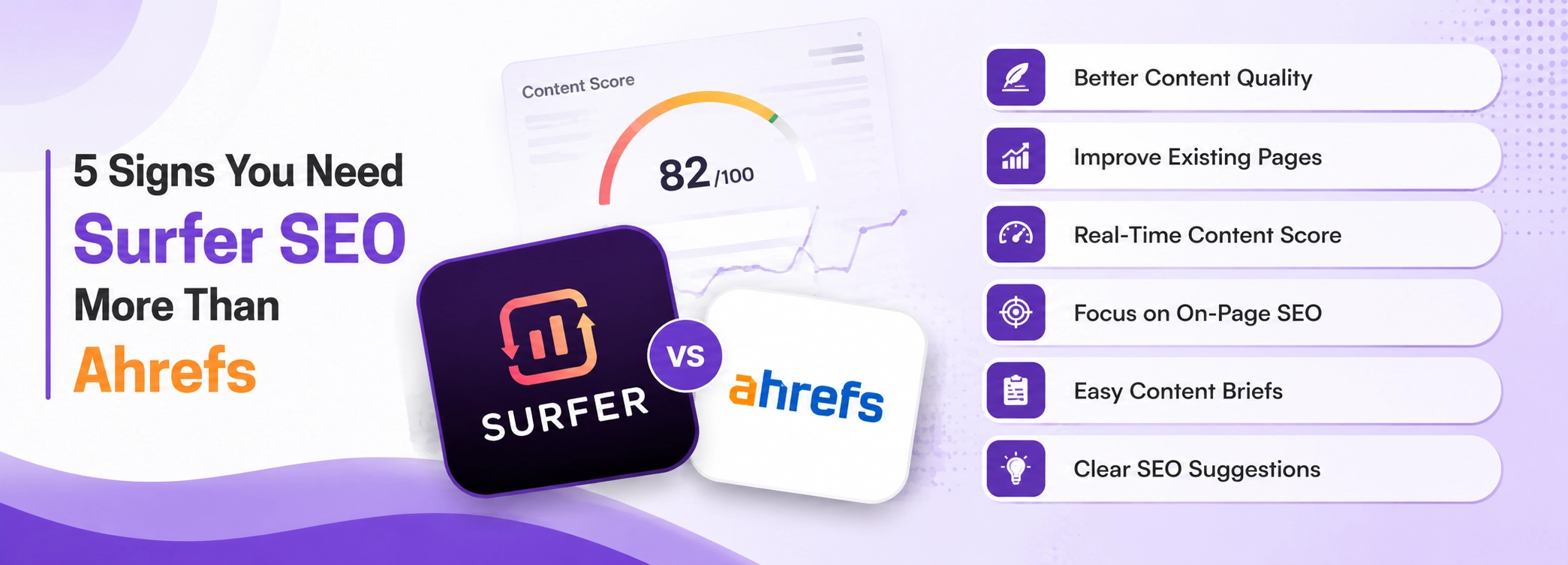
Some businesses lean harder toward one tool. Here are signs. Surfer fits your situation better:
- Your main challenge is content quality and structure, not backlinks
- You already have decent rankings and want to optimize existing pages further
- You need real-time content scoring while your team writes
- Your focus sits on page SEO more than link building
- You want guided content briefs that keep freelance writers consistent
Surfer SEO vs Ahrefs: Content Optimization Compared
Surfer’s content editor gives writers a live score and specific term suggestions as they type. Ahrefs takes a different approach through its content gap tool, which shows keywords competitors rank for that a given page misses entirely.
Non-technical writers tend to find Surfer easier to use day-to-day, since the interface reads more like a writing assistant than a data dashboard. Ahrefs demands a bit more SEO knowledge to interpret correctly, though its on-page recommendations run deeper once someone learns the platform.
Surfer SEO vs Ahrefs: Keyword Research Compared
Keyword difficulty scores differ between the two platforms, and neither number tells the full story on its own. Ahrefs pulls from a massive backlink index to calculate difficulty, while Surfer leans more on content-based signals from ranking pages.
Search volume accuracy also varies depending on data sources and country coverage. Long-tail keyword discovery works well in both tools, though Ahrefs tends to surface a wider net of related terms thanks to its larger overall database.
Surfer SEO vs. Ahrefs: Backlink and Technical SEO Compared
Ahrefs holds a clear edge here. Its backlink database ranks among the largest in the industry, giving users a detailed look at referring domains, anchor text, and link quality over time.
Technical site audits inside Ahrefs catch crawl errors, broken links, and indexing problems across large sites. Domain authority tracking and competitor backlink monitoring give teams a full picture of where they stand against rivals, something Surfer simply was not built to handle.
Comparison Table 1: Surfer SEO vs. Ahrefs Core Features
| Feature | Surfer SEO | Ahrefs |
| Content optimization | Strong, real-time scoring | Basic, gap-based only |
| Keyword research depth | Moderate | Strong |
| Backlink analysis | Not available | Strong |
| Technical SEO auditing | Limited | Strong |
| Pricing tiers | Lower entry cost | Higher entry cost |
| Ease of use | Beginner-friendly | Steeper learning curve |
Why Neither Tool Replaces the Need to Hire an SEO Expert
Tools hand you data. They do not hand you a strategy. A dashboard full of scores and metrics still needs someone to interpret what matters and what doesn’t for a specific business.
Neither Surfer nor Ahrefs understands your business goals, your customer base, or your competitive landscape the way a person does. Human judgment decides which recommendations actually move rankings and which ones just look good on a report. This is exactly why businesses often hire an SEO expert rather than hand a junior team member a software login and hope for the best.
What an Organic SEO Agency Does With Tools Like Surfer and Ahrefs
An organic SEO agency treats tool data as an input, not a final answer. Strategists pull numbers from Surfer and Ahrefs, then combine those insights with market research, client history, and search intent before making a single content decision.
This blended approach means recommendations from one tool get checked against another, and the final strategy reflects a fuller picture than either platform provides alone. Translating raw tool output into actual content briefs, technical fixes, and link-building campaigns takes practiced judgment that a subscription cannot replicate.
How an Organic SEO Specialist Uses These Tools Differently Than a Beginner
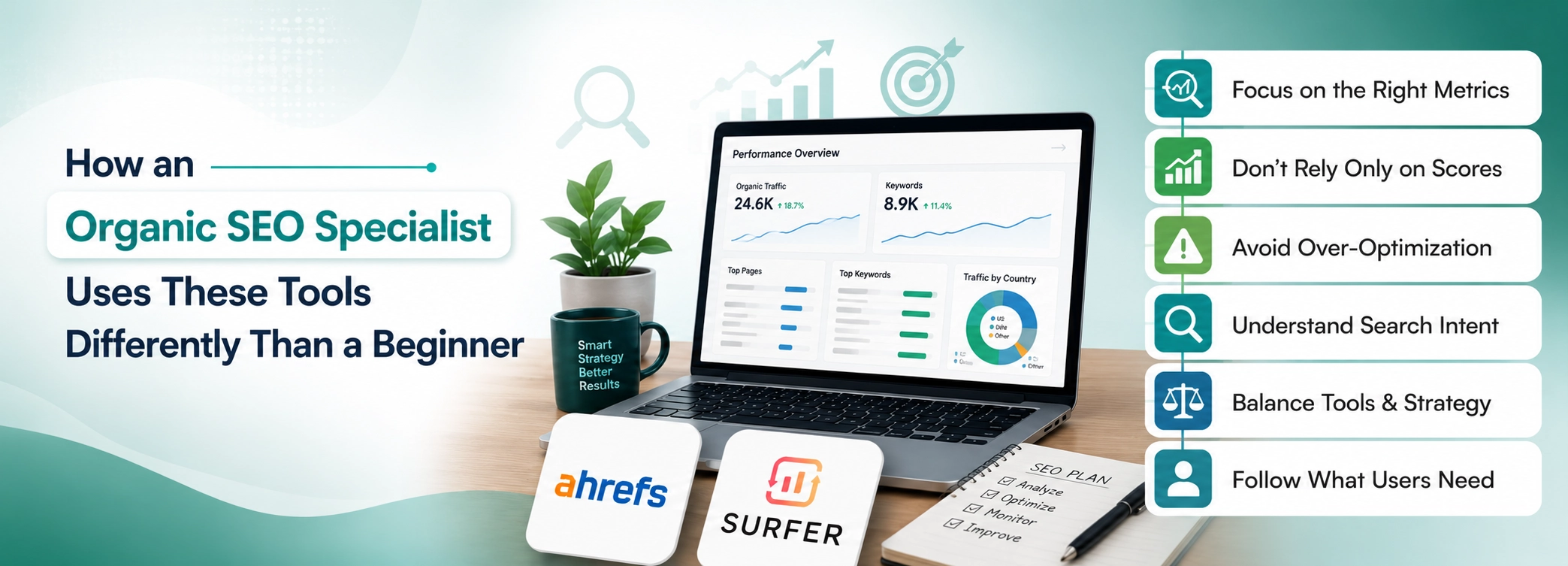
An experienced organic SEO specialist knows which metrics actually matter for a given goal and which ones amount to noise. A beginner might chase a perfect Surfer score, while a specialist recognizes when a slightly lower score still serves the reader better.
Over-optimization based purely on tool numbers can hurt more than help, since search engines reward content that reads naturally. A specialist balances every tool suggestion against real search intent, making sure the final page answers what searchers actually want rather than what a score demands.
6 Reasons Businesses Hire Dedicated SEO Expert Help Instead of Just Buying Tools
- Tools require someone skilled enough to interpret and act on the data correctly
- Subscription costs often go to waste when features sit unused
- Experienced strategy delivers faster results than trial and error
- Search algorithms shift constantly, and ongoing adjustments require expertise
- Combining SEO with content and technical execution takes more than software
- Business owners save time better spent running daily operations
Businesses that decide to hire a dedicated SEO expert support usually see this pay-off within a few months, since strategy moves faster than guesswork ever could.
Get a custom SEO strategy built around your business, not a generic template pulled from a tool score.

 Chat on WhatsApp
Why the Best Content Marketing Agencies Use These Tools as a Starting Point, Not the Strategy Itself
The best content marketing agencies treat Surfer and Ahrefs data as a launchpad for topic and keyword selection, never as the finished strategy. Human writers and strategists shape the actual voice, structure, and depth of every piece from there.
Content that follows a tool’s suggestions word-for-word tends to read generic and forgettable. Skilled teams avoid that trap by layering real expertise, brand voice, and reader value on top of whatever the software recommends.
How a Content Marketing Specialist Balances Tool Data With Original Writing
A skilled content marketing specialist uses tool scores as a guide rather than a rulebook carved in stone. The goal stays focused on reader value first, with optimization suggestions serving as support rather than the main driver.
Content built purely to satisfy a score often reads stiff and mechanical. A specialist writes for the person on the other end of the screen, then checks the piece against tool recommendations afterward rather than the reverse.
Why Best Content Marketing Companies Rarely Rely on Just One Tool
The best content marketing companies combine Surfer, Ahrefs, and additional platforms to build a complete strategy rather than betting everything on one dashboard. Cross-referencing data before major content decisions catches blind spots that a single tool might miss entirely.
Reddit shows real conversations, Ahrefs shows competitive gaps, and Surfer shows on-page structure. Together they paint a picture no single source can offer on its own.
How a Social Media Marketing Consultant Fits Into the Bigger SEO Picture
A social media marketing consultant plays a bigger role in SEO success than most business owners realize. Content that ranks well in search often gets shared and amplified across social channels, extending its reach far past the original search result.
Aligning SEO content strategy with social promotion creates a feedback loop between the two channels. Engagement data from social platforms can also inform future content decisions, showing which topics resonate before a writer even opens a keyword tool. Redefining Web has built entire campaigns around this exact overlap, pairing organic content with social distribution so neither channel works in isolation.
Comparison Table 2: Tool-Only Strategy vs. Tool-Assisted Human Strategy
| Factor | Tool-Only Strategy | Tool-Assisted Human Strategy |
| Content quality | Generic, score-driven | Reader-focused, natural |
| Strategic direction | Reactive to software output | Proactive, goal-based |
| Adaptability | Slow to adjust | Fast, informed by expertise |
| Long-term results | Inconsistent | Steady growth over time |
| Resource efficiency | Wasted subscriptions | Full value from every tool |
Which Tool Is Better If You Can Only Choose One
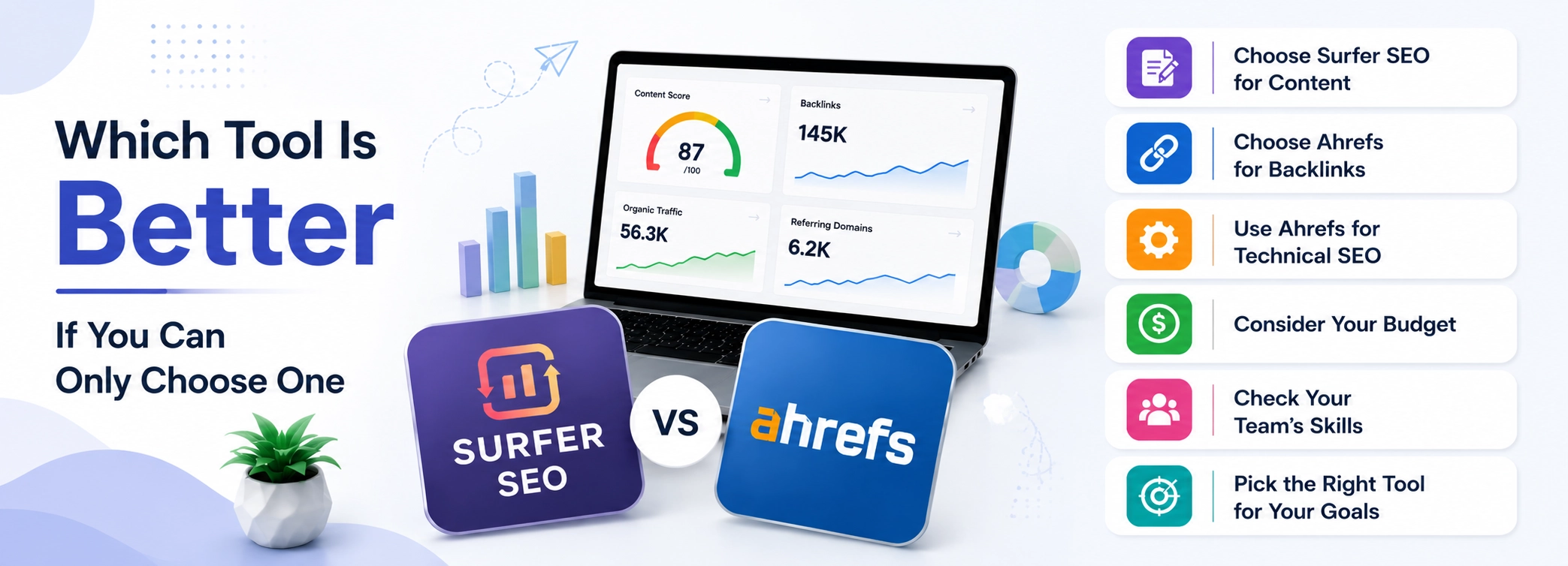
Choose Surfer SEO if content optimization sits at the top of your priority list and your team writes often. Choose Ahrefs if backlinks and technical site health matter more to your current situation.
Budget and team skill level also play a role in this decision. A small team without much SEO background might find Surfer’s guided approach easier to adopt quickly, while a larger team with existing SEO knowledge can extract more value from Ahrefs right away.
Why Social Media Marketing Services Should Complement Your SEO Investment
Strong social media marketing services drive additional traffic and brand visibility that search alone cannot deliver. Distribution beyond organic rankings gives content a second life across platforms where audiences already spend their time.
Brand recognition built through consistent social presence also supports SEO trust signals indirectly. Search engines notice when a brand shows up consistently across channels, and that consistency can support long-term ranking stability.
5 Questions to Ask Before You Hire a SEO Expert to Manage These Tools
- Which tools do you use, and why did you choose them
- How do you turn tool data into actual content and technical strategy
- Can you show results from using these tools effectively for past clients
- How do you decide which recommendations to prioritize first
- How often does the strategy get adjusted based on new data
How to Know If You Need Tools, an Expert, or Both
Small businesses with limited budgets often benefit most from expert-guided tool use rather than buying every platform outright. A skilled consultant can extract far more value from one well-chosen tool than a business owner working alone with several.
Larger businesses usually need dedicated in-house or agency support to manage the volume of data these platforms generate. Recognizing when DIY tool use has hit its ceiling saves both time and money, especially once growth demands a more structured approach.
Closing Thoughts
Surfer SEO vs. Ahrefs ultimately comes down to two tools solving different problems, and the real advantage comes from knowing how to use either one strategically rather than picking a side in a manufactured battle. Tools support good SEO work, but they never replace the judgment and strategy a real expert brings to the table, which is the exact gap teams like Redefining Web fill for businesses that want results without managing every dashboard themselves.
Reach out for a free SEO strategy consultation or a custom quote built around your specific goals.
Frequently Asked Questions About SEO or Ahrefs


Know your website’s SEO Score.
Get a customized SEO Audit report & improve your website statistics.