Skip to main content



Search engines have changed. Not slightly. Fundamentally.
Google no longer just matches keywords to pages. It reads context, maps intent, and understands the relationship between topics across an entire website. Businesses that still rely on outdated optimisation methods lose rankings every month. Most do not realise why until the traffic numbers tell a painful story.
AI SEO services exist to fix that problem. They combine machine learning, natural language processing, and automation to deliver faster, sharper, and more reliable search optimization than any manual process can. Better rankings follow. Stronger organic traffic follows. A clear edge over competitors who have not yet made the switch follows, too.
This article covers exactly what full-service AI SEO agencies offer, how they work, and why businesses across every sector are moving away from traditional SEO right now.
Stop Losing Rankings to Competitors Who Use AI

 Chat on WhatsApp
What Are AI SEO Services
AI SEO means using artificial intelligence tools directly inside the search engine optimisation process. Instead of relying on manual research and monthly audits, AI-powered optimisation analyses data without stopping, spots patterns faster than any human analyst, and delivers recommendations that a manual team would need weeks to produce.
Traditional SEO rests on manual keyword research, reactive content decisions, and periodic performance reviews. AI works the opposite way on every single count.
Here is how the two approaches compare:
| Feature | Traditional SEO | AI SEO |
| Keyword Research | Manual | AI-Powered |
| Content Planning | Reactive | Predictive |
| Technical Audits | Periodic | Continuous |
| Competitor Tracking | Limited | Real-Time |
| Reporting | Monthly | Live Dashboards |
| Scalability | Moderate | High |
The real difference is not just speed. It is accuracy. AI tools process thousands of data points at once and surface opportunities that manual methods miss completely. That is the core distinction between businesses that grow through search and those that stay stuck.
Why AI SEO Matters More Than Ever in 2026
Google has changed at a structural level. AI Overviews now appear at the top of results for millions of queries. Generative search answers questions directly on the results page. Many users never click through to a website at all.
That changes how visibility works. Completely. Businesses that only optimise for traditional blue-link rankings now miss a large part of the search landscape. AI-powered search rewards topical authority, semantic depth, and well-structured content. Sites that cover a subject properly, not just on the surface, and perform better in both standard results and AI-generated answer boxes.
Search behaviour has also shifted. Queries are longer now. More conversational. Users want precise answers fast. They trust sources that show real depth rather than sites that chase high-volume keywords with thin, shallow content.
An agency that understands these changes and uses AI tools to adapt gives clients a real, measurable advantage. One that still works from an outdated method leaves clients exposed to traffic drops they will not see coming.
How an AI SEO Agency Works
Understanding how an AI SEO agency actually operates helps businesses separate genuinely AI-powered providers from those simply using the label to attract clients without the capability to back it up.
A properly built AI SEO agency works through four clear stages:
-
AI-Powered Data Collection: Tools pull data from search engines, competitor sites, backlink profiles, technical performance metrics, and user behaviour signals. This runs around the clock, not on a fixed monthly schedule that leaves large gaps between reviews.
-
Automated Analysis and Recommendations: Algorithms process all that data to surface ranking opportunities, technical faults, content gaps, and link-building prospects. The speed advantage over manual analysis is not small. It is enormous.
-
Human Expertise Combined With AI Tools: Technology handles volume and speed. Human strategists read the findings, apply judgement, and build campaigns around real business goals. Neither element delivers full results without the other.
-
Continuous Optimisation and Monitoring: AI systems flag problems and opportunities as they appear rather than at the next scheduled review. Teams act quickly. Issues get resolved before they become sustained ranking drops.
The model works because it removes the delay between data and action. That delay is exactly where rankings and traffic get lost under traditional SEO methods.
Core Services Offered by the Best AI SEO Agencies
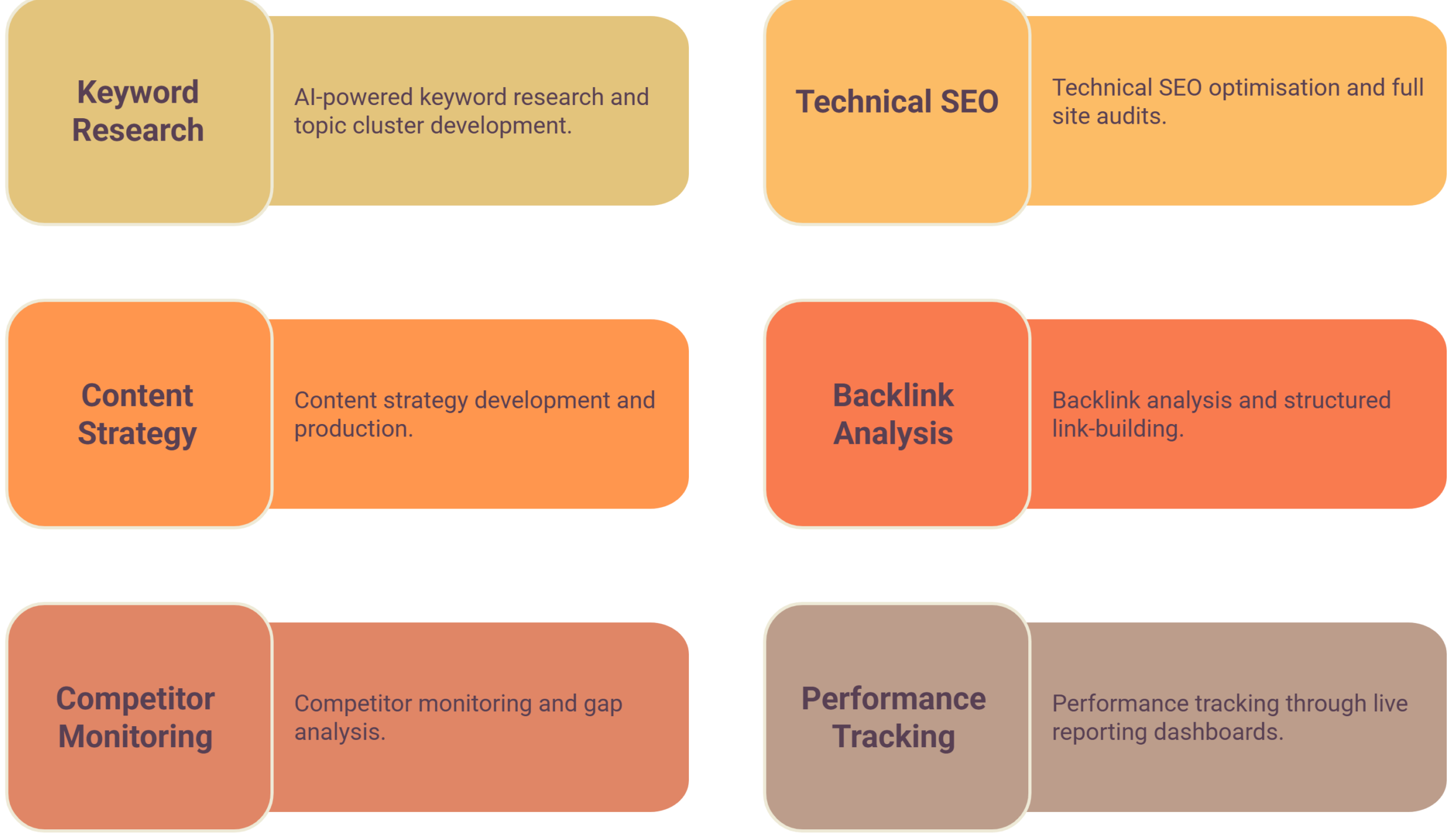
A full-service offering from the best AI SEO agencies covers the entire search optimisation process from start to finish. These are the core services included:
- AI-powered keyword research and topic cluster development
- Technical SEO optimisation and full site audits
- Content strategy development and production
- Backlink analysis and structured link-building
- Competitor monitoring and gap analysis
- Performance tracking through live reporting dashboards
Every one of these services improves with AI. Keyword research that once took days now takes hours. Technical audits that caught issues once a month now catch them the moment they appear. Content strategies that once relied on guesswork now rest on solid, verifiable data.
Agencies that offer only one or two of these services cannot deliver the compounding effect that a fully connected approach produces over time. Partial solutions produce partial results. Simple as that.
AI-Powered Keyword Research and Topic Clustering
Keyword research has moved well beyond a list of high-volume phrases. AI tools now map search intent, build topic clusters, and expose content gaps that competitors have missed entirely.
The process covers four distinct areas:
-
Finding High-Value Opportunities:
AI analyses search volume, competition level, and ranking difficulty across thousands of keywords at once. It then ranks those keywords by return on investment, so effort goes exactly where it matters most. -
Search Intent Mapping:
The reason behind a search matters more than the search term itself. AI classifies intent as informational, navigational, or transactional so that every piece of content matches what users actually want to find. -
Building Topical Authority:
Search engines reward sites that cover subjects thoroughly rather than touching on them briefly. AI maps related subtopics and builds content clusters that show genuine expertise to search algorithms. - Content Gap Analysis:
Comparing a client’s existing content against competitor coverage reveals exactly where the opportunity sits. AI makes this fast, thorough, and directly actionable rather than a slow, manual process that still misses things.
Technical SEO Services Enhanced by AI
Technical SEO is the foundation on which everything else rests. Without it, strong content struggles to rank regardless of quality or depth. AI tools close the gap that periodic manual audits always leave open between review cycles.
Key technical services include the following:
-
Site Audits:
Full crawls that assess site health across hundreds of technical factors at once, rather than in slow sequence -
Crawl Error Detection:
Identification of broken links, redirect chains, and indexing problems before they affect rankings and traffic -
Core Web Vitals Optimisation:
Direct improvements to loading speed, visual stability, and interactivity scores that Google treats as hard ranking signals -
Schema Markup Implementation:
Structured data that helps search engines understand page content and serve rich results directly in search -
Indexing Improvements:
Confirmation that search engines can reach, crawl, and index every important page without obstruction - AI-powered monitoring:
runs constantly. Manual technical audits happen occasionally. That difference means problems get caught before they turn into traffic losses rather than after the damage has already taken hold.
How AI Improves Content Optimisation
Content is still the primary currency of SEO. AI changes how content gets planned, produced, and kept relevant over time rather than left to decay once it goes live.
-
NLP-Driven Content Recommendations:
Natural language processing analyzes top-ranking pages to identify effective terms, structures, and topic coverage. This allows writers to rely on data-backed insights instead of assumptions.
-
Semantic Keyword Integration:
AI suggests semantically related keywords that improve topical relevance without relying on repetitive exact-match phrases, reducing the risk of over-optimisation penalties.
-
Search Intent Matching:
Content that directly answers user queries in the appropriate format ranks better than keyword-heavy content. AI evaluates whether content satisfies intent and highlights specific areas for improvement.
- Content Refresh Strategies:
As rankings decline over time, AI identifies pages that need updates and recommends precise improvements to regain lost positions and stay competitive.
AI SEO for Google AI Overviews and Generative Search
-
AI-Generated Search Results:
Demand a completely different optimisation approach. A high-ranking page alone no longer guarantees visibility in Google AI overviews. Content must meet high standards of trust, structure, and authority to be selected as a direct answer.
-
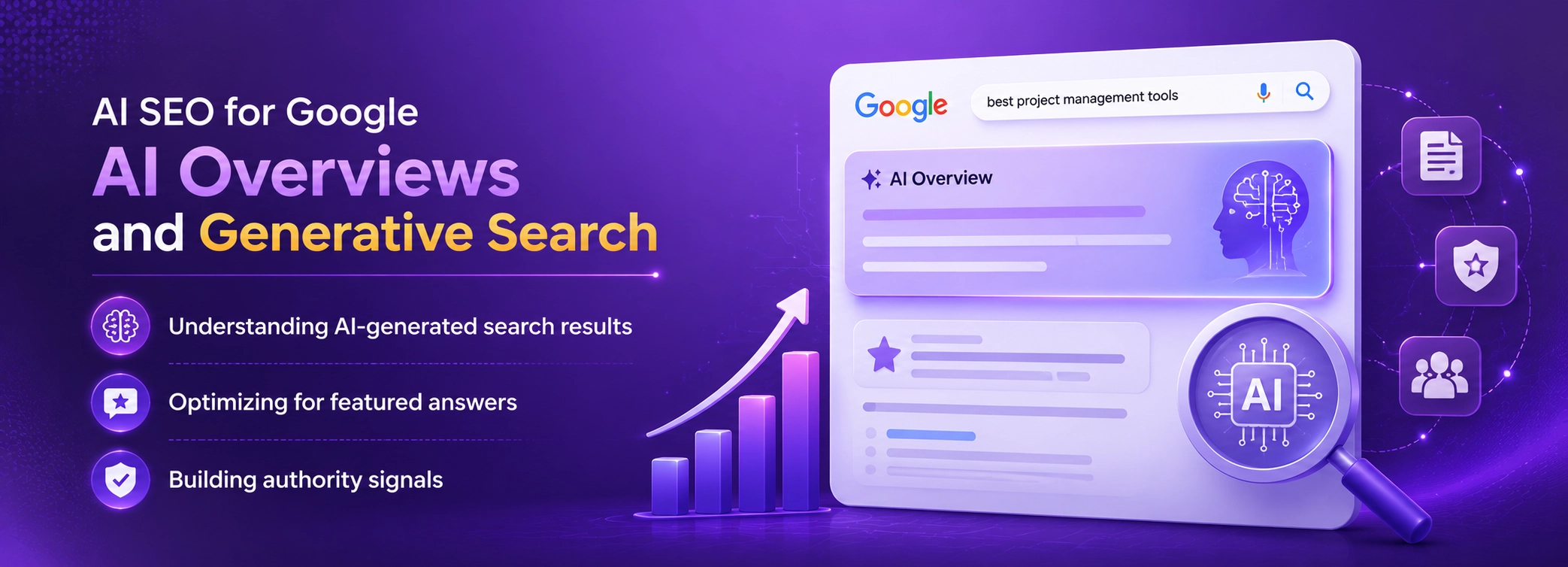
Understanding AI-Generated Search Results:
Google selects content for AI overviews based on authority, accuracy, and clear structure. Depth and formatting are critical—thin or vague content is unlikely to be chosen, regardless of rankings.
-
Optimising for Featured Answers:
Content structured around direct questions with concise, well-organised answers performs better in AI-generated results. Using clear headings, bullet points, and precise definitions helps search engines extract and display information effectively.
- Building Authority Signals:
Strong backlinks, consistent publishing, proven author expertise, and solid technical performance all contribute to trust signals. These factors determine which sites are featured in AI-driven results, and building authority requires ongoing effort.
How AI SEO Agencies Analyse Competitors Faster
-
Competitor Analysis:
AI delivers some of the most dramatic improvements over traditional manual methods. The shift from monthly reports to real-time data enables faster, more informed decision-making.
-
Real-Time Market Intelligence:
AI tools continuously monitor competitor rankings, content updates, and backlink growth. Insights are delivered instantly instead of weeks later, keeping strategies relevant and actionable.
-
Keyword Opportunity Discovery:
AI maps complete competitor keyword footprints, identifying gaps where a client is not ranking. Each gap represents a clear, actionable growth opportunity.
-
Backlink Gap Analysis:
AI compares backlink profiles to find domains linking to competitors but not to the client, turning them into high-priority outreach targets with strong success potential.
- Trend Forecasting:
By analyzing historical search patterns, AI predicts emerging trends early—allowing businesses to secure rankings before competition intensifies.
Benefits of Hiring an AI SEO Consultancy
Working with a proper AI SEO consultancy produces advantages that stretch well beyond faster keyword research or automated reporting.
-
Faster Decision-Making:
Search performance changes fast. AI-powered agencies respond to those changes without waiting for the next scheduled review to arrive weeks down the line, when the moment has already passed. -
Better Resource Allocation:
AI identifies which activities produce the strongest returns for a specific business in a specific market. Budget and time go toward high-impact work rather than being spread thinly across tasks with weak returns. - Improved Ranking Opportunities:
Thorough analysis produces a better strategy. A better strategy produces more consistent ranking results over a longer period. The compounding effect is real and measurable. - Long-Term Growth Planning:
AI tools model performance trajectories and show businesses what consistent SEO investment will produce over months and years, not just the next reporting cycle.
Common SEO Challenges AI Can Solve
Many businesses face the same SEO problems repeatedly. Traditional approaches treat the symptoms. AI addresses the root cause directly and stops the same issues from resurfacing month after month.
| SEO Challenge | How AI Solves It |
| Low Rankings | Identifies precise gaps in content depth and authority signals |
| Poor Content Performance | Analyses intent alignment and surfaces targeted improvement areas |
| Technical Website Issues | Detects faults in real time before they grow into sustained ranking drops |
| Keyword Cannibalisation | Maps content overlap and recommends a clear consolidation approach |
| Declining Traffic | Pinpoints the exact source of ranking losses and drives a fast, data-backed response |
Industries That Benefit Most From AI SEO Services
AI SEO works across sectors. Some industries see stronger returns because of the complexity and competition level that manual methods simply cannot keep pace with:
- E-Commerce: Large product catalogues need constant monitoring across hundreds of pages. AI sustains that at scale, where manual processes break down.
- SaaS: Long sales cycles demand visibility across informational and transactional queries at every funnel stage at the same time.
- Healthcare: Regulated content needs precise intent alignment and strong authority signals to rank, convert, and stay compliant.
- Legal: Competitive keywords need technical excellence and a strong backlink profile built through consistent, targeted outreach.
- Real Estate: Local and national visibility both matter. AI manages the complexity across multiple markets without dropping the ball.
- Financial Services: Trust and accuracy carry extra weight here. A single error in content or technical structure costs credibility fast.
- Professional Services: Authority and expertise signals determine who ranks. Reputation drives every decision in this sector.
Why Businesses Trust Redefining Web for AI SEO Services
Choosing the right AI SEO service partner matters as much as the technology itself. Tools only produce results when the people who use them understand the strategy the data points toward and know how to act on it decisively.
Redefining Web delivers advanced AI-powered SEO solutions that produce measurable, documented growth for clients across industries. Their approach connects technical optimisation expertise with data-driven content strategy, transparent reporting, and a long-term partnership focus centred on real business outcomes rather than vanity metrics that look good in a report but mean nothing for actual revenue.
Clients receive live dashboards, clear ROI tracking, and strategies built around specific growth targets. The SEO programme that results from this approach compounds over time. Authority builds. Traffic grows. Conversions increase consistently month after month.
AI SEO Success Story: Real Business Growth
To understand what AI SEO companies can deliver in practice, the numbers from a focused AI-powered campaign make the case clearly.
Business Challenge:
- Low search visibility despite an established website with existing content
- Weak keyword rankings across core product and service terms
- Poor organic conversion rate from the traffic that did arrive
AI SEO Strategy Implemented:
- AI keyword cluster analysis to identify high-value topic groups with clear search intent
- Technical fixes across Core Web Vitals and crawl accessibility issues found through continuous monitoring
- NLP-driven content optimisation across all key landing pages to match user intent precisely
- Smart internal linking to distribute authority across the entire site structure
Results After 6 Months:
- 160% increase in organic traffic
- 50+ keywords ranked in the top ten positions
- 35% increase in conversion rate from organic visitors
- Stronger engagement metrics across all key pages
These results reflect what a data-driven SEO strategy delivers when AI tools replace guesswork with evidence and allow teams to act on what the data actually shows.
Final Thoughts on AI SEO Services
Traditional SEO had its time. That time has passed. Search engines now understand context, reward authority, and surface answers directly on the results page. Businesses that still rely on manual, periodic optimisation are not just behind. They are actively losing ground to competitors who have already made the switch. AI SEO removes the guesswork, closes the gap between data and action, and builds a search presence that compounds over time rather than plateauing after a few quick wins.
Redefining Web builds every AI SEO service campaign around AI-powered strategy, technical expertise, and transparent reporting. No vague promises. Just better rankings, stronger traffic, and consistent growth.
Ready to See What AI SEO Can Do for Your Business?
Frequently Asked Questions about AI SEO Services


Know your website’s SEO Score.
Get a customized SEO Audit report & improve your website statistics.