Skip to main content


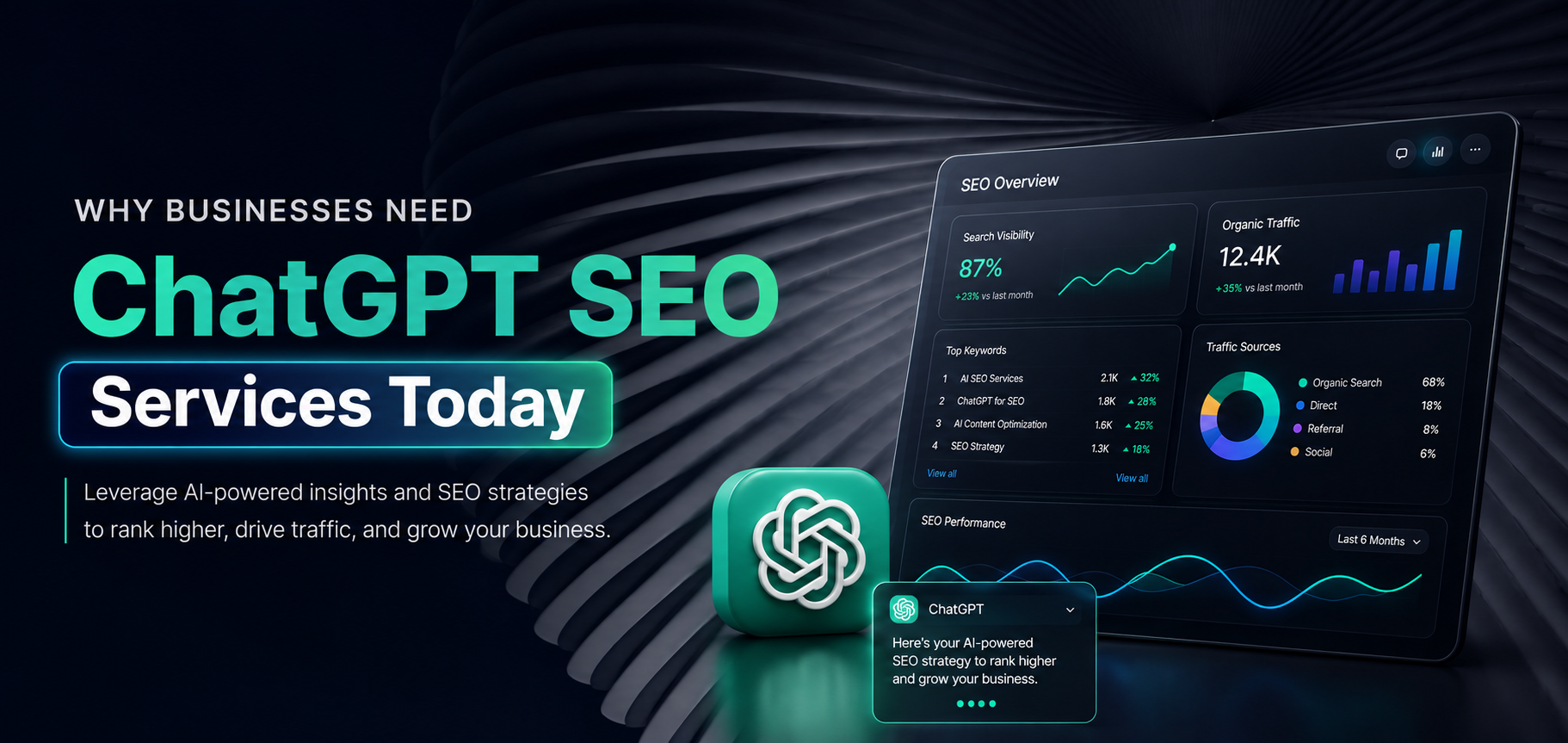
Search has changed permanently. Customers no longer scroll through pages of results to find what they need. They ask AI assistants, get a direct answer, and move on. If your business does not appear in that answer, you lost that customer before they ever knew you existed.
This is not a slow shift. Millions of queries go through ChatGPT, Google AI Overviews, and similar tools every single day. The brands that show up in those answers earn trust, traffic, and real leads. The brands that do not simply vanish from the customer’s decision-making process.
ChatGPT SEO services were built to fix exactly this problem. They help businesses structure their online presence so AI tools can find, trust, and cite them when users ask relevant questions. Traditional SEO alone cannot deliver this. A different approach is needed.
This article by Redefining Web covers what AI search optimisation actually involves, why businesses cannot afford to skip it, and how a well-built strategy drives growth you can measure.
Future-Proof Your Business Visibility Today

 Chat on WhatsApp
What Are ChatGPT SEO Services
ChatGPT SEO is the process of optimising a business’s digital presence so that AI-powered tools, including ChatGPT, Google’s AI Overviews, and similar platforms, can find, understand, and recommend that business in response to user queries.
Traditional SEO focuses on ranking web pages for specific keywords. AI search optimisation does something different. It builds structured, authoritative, and entity-rich content that AI models actually draw on when they generate answers.
Both approaches matter. But they serve different purposes:
- Traditional SEO targets search engine rankings for keyword-based queries
- AI SEO targets visibility within AI-generated answers and conversational search responses
The core components of modern AI-driven SEO are entity optimisation, topical authority, structured data, content ecosystems, and brand mentions built across the wider web. Without these, even a technically strong website can remain invisible to AI tools.
Why Search Behaviour Is Rapidly Changing
People no longer type two-word search queries. They phrase questions the way they would speak to a colleague. Instead of searching “dentist London,” a user now asks “which dentist in London is best for nervous patients?” AI tools answer those questions directly. No click required.
What this shift actually costs businesses:
- AI-generated answers replace the traditional click to your website
- Brand visibility now depends on whether AI tools recognise your authority
- Businesses not cited in AI answers lose exposure at the exact moment a customer makes a decision
- Lead generation drops when AI tools point customers toward competitors instead
This is not something to plan for in the future. It is already happening across every industry. Businesses that wait to adapt hand market share directly to competitors who act now.
The Business Risks of Ignoring AI Search Optimisation
Skipping AI search optimisation is not a neutral decision. The consequences build quietly and become harder to reverse the longer a business waits.
-
Loss of organic visibility:
When AI tools generate answers without mentioning your brand, your traffic can decline even if your traditional SEO rankings remain unchanged. -
Reduced brand mentions:
AI assistants cite sources they trust. Businesses without strong authority signals are unlikely to appear in those citations. -
Competitor advantage:
Every competitor that builds AI search authority today widens the gap over time. Early adopters secure positions that become increasingly difficult for later entrants to displace. - Missed customer acquisition:
A customer who receives a complete and satisfying AI-generated answer is less likely to continue searching. If your brand is not included in that answer, you may lose the opportunity to acquire that customer.
How ChatGPT SEO Services Improve Brand Discoverability
AI tools do not rank pages the way search engines do. They build a model of entities, topics, and relationships. To appear in AI answers, a business needs to make itself legible to those systems.
-
Entity-based optimisation:
Structure information about your business, services, and expertise so AI models can accurately understand what you do and who you serve. -
Knowledge graph visibility:
Ensure your business appears accurately within the interconnected web of information that AI systems use to construct answers. -
Topical authority:
Build authority by publishing comprehensive, expert-led content across your niche. AI tools are more likely to cite brands they recognise as credible and reliable sources. - Citation opportunities:
Increase your brand’s visibility by earning genuine mentions across reputable websites, industry directories, publications, and authoritative platforms. Each mention strengthens the trust AI tools place in your business.
Key Benefits of Investing in ChatGPT SEO Services
Businesses that invest in AI search optimisation gain advantages that compound over time.
| Benefit | Impact |
| Increased organic traffic | More visitors from both AI and traditional search |
| Better AI search visibility | Brand appears in AI-generated answers |
| Enhanced brand credibility | Customers trust brands AI tools recommend |
| Improved lead generation | Higher-quality enquiries from intent-driven searches |
| Long-term digital growth | Authority built now supports future visibility |
These results do not arrive in the first week. AI search optimization is a sustained investment. The businesses that build authority now will hold a real, compounding advantage over those who start later.
Understanding the Connection Between AI SEO and Organic SEO Services
Organic SEO services and AI SEO are not competing strategies. They are two layers of the same foundation.
Traditional organic SEO handles the technical groundwork: page speed, crawlability, internal linking, and keyword relevance. AI SEO builds on top of that by adding entity depth, topical breadth, and content structured specifically for AI citation.
Content strategies that serve both approaches:
- Write comprehensive, expert-led content that answers questions fully rather than partially
- Use structured data to help both search engines and AI tools interpret your pages accurately
- Build content clusters that demonstrate authority across an entire subject area, not just a single page
- Earn high-quality backlinks that act as authority signals for both traditional and AI search
Businesses that combine both approaches build the most resilient digital presence. Neither works as well without the other.
How an AI SEO Agency Helps Businesses Win in AI Search
Most internal marketing teams do not yet have the tools, frameworks, or experience to handle AI SEO effectively. A specialist AI SEO agency closes that gap.
A specialist agency delivers:
-
AI visibility audits
that show exactly where your brand currently appears in AI-generated answers and where the gaps are -
Structured content creation
designed for AI citation rather than just search engine rankings -
Entity optimisation
that ensures AI systems have a clear, accurate understanding of your business - Performance monitoring
that tracks AI citation frequency, brand mention growth, and associated traffic changes over time
AI search evolves fast. Businesses need continuous optimisation, not a one-time project. A good agency manages that ongoing process while your team stays focused on running the business.
Industries Benefiting Most from ChatGPT SEO Services
AI search optimisation delivers results across many sectors. Certain industries see the strongest returns.
-
SaaS companies:
Benefit because buyers extensively research software solutions through AI tools before they ever speak to a sales team. -
Healthcare providers:
Reach patients who use AI assistants to find qualified practitioners and understand treatment options before booking an appointment. -
Ecommerce brands:
Connect with customers during the research stage, before purchase intent shifts toward a specific competitor. -
Local businesses:
Appear in AI-generated recommendations for location-specific searches, which often carry strong purchase intent. - Professional service firms:
Including legal, financial, and consulting businesses, build credibility through AI citations that reinforce their expertise.
Common Problems Businesses Face Without AI Search Visibility
Businesses that lack AI search visibility tend to encounter the same problems repeatedly:
-
Declining website traffic
despite stable or improved traditional SEO rankings -
Low brand recognition
among customers who rely on AI tools for research -
Weak online authority
that blocks AI citation regardless of how much content a business publishes - Inconsistent lead generation
because customers find competitors in AI answers instead of finding them
These problems do not fix themselves. Without deliberate effort to build AI search visibility, the gap between AI-visible and AI-invisible businesses widens every month.
ChatGPT SEO vs Traditional SEO
| Factor | Traditional SEO | ChatGPT SEO |
| Primary Goal | Search rankings | AI answer visibility |
| Focus | Keywords | Entities and topics |
| User Intent | Search results | Conversational answers |
| Content Strategy | Ranking pages | AI-citable content |
| Authority Signals | Backlinks | Authority and mentions |
| Visibility | SERPs | AI assistants and SERPs |
| Long-Term Value | High | Very High |
The Role of Content Marketing in AI Search Success
Content sits at the centre of every AI search strategy that actually works. AI tools cite content that demonstrates real expertise, answers questions completely, and comes from sources with genuine credibility.
- Best content marketing agencies
Produce content that meets both traditional SEO and AI search requirements. They build comprehensive content ecosystems rather than isolated articles, covering topics with enough depth for AI tools to recognise the brand as a trusted authority. - Content marketing specialists
Help businesses move beyond generic articles by creating expert-led, well-structured content that consistently earns AI citations. Generic content rarely gets cited, while authoritative content with clear expertise and attribution is far more likely to be referenced.
How Top ChatGPT SEO Agencies Approach Optimisation
Top ChatGPT SEO agencies follow a clear methodology built on authority, structure, and depth. They do not chase shortcuts.
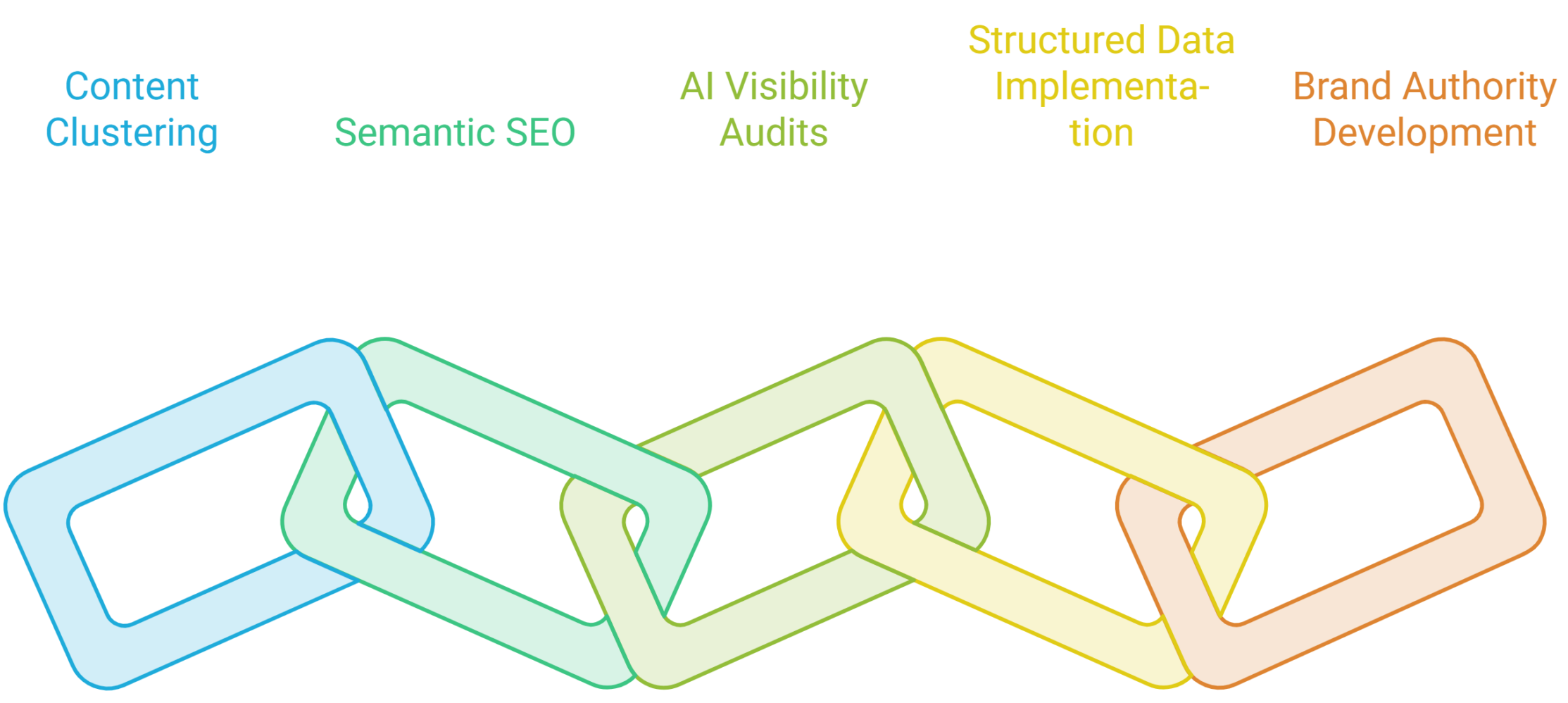
Their approach typically covers:
-
Content clustering
that builds comprehensive topic coverage rather than scattered, unconnected pages -
Semantic SEO strategies
that help AI tools understand the relationships between topics, entities, and concepts within a niche -
AI visibility audits
that assess current citation performance and identify where to focus effort first -
Structured data implementation
that makes content easier for AI systems to process and reference accurately - Brand authority development
through earned media, strong backlinks, and consistent entity optimisation across the web
Technical Foundations That Support AI Visibility
Strong technical performance remains essential. AI tools favour content from technically sound websites because those signals contribute to overall credibility assessment.
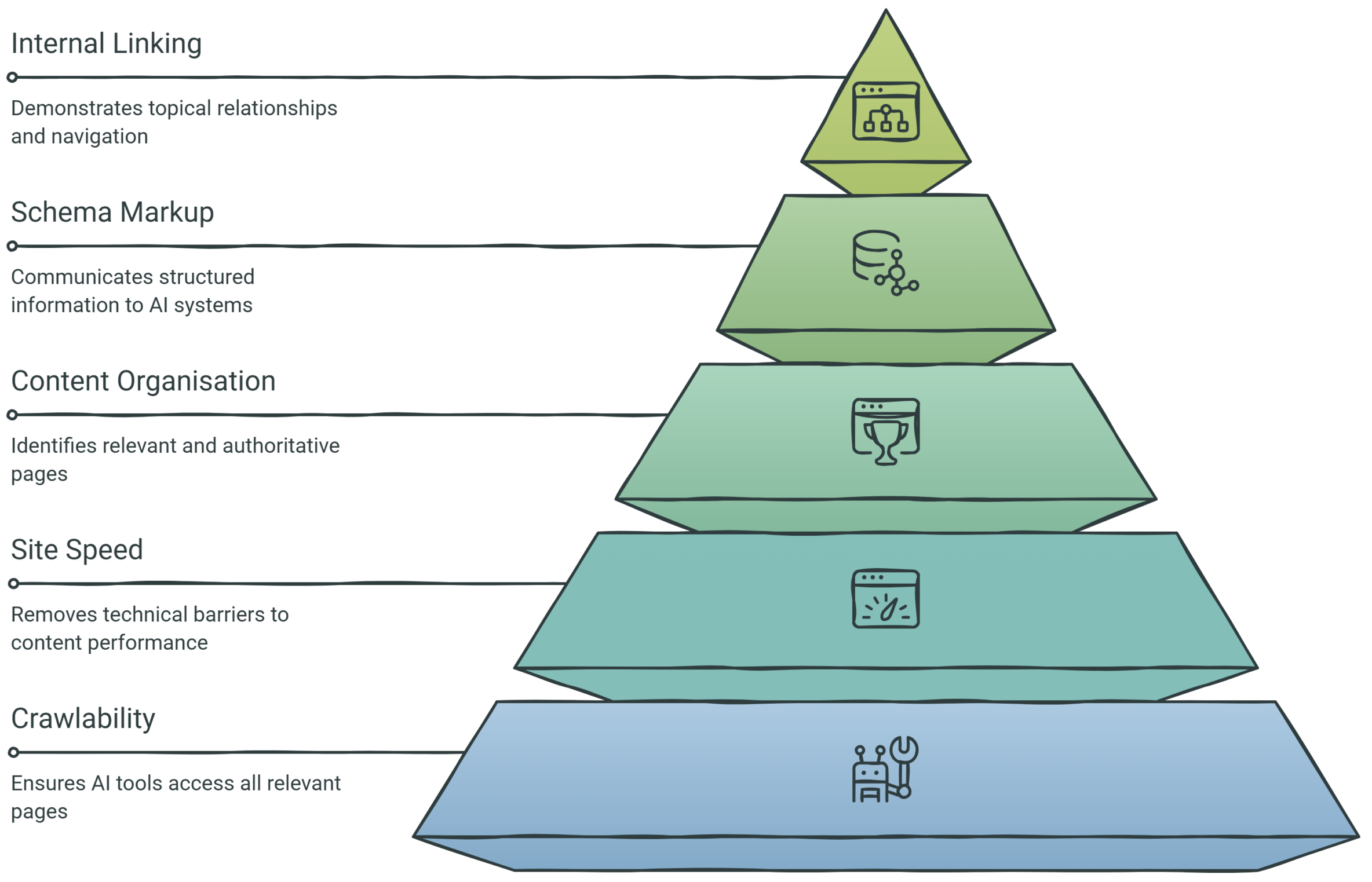
Critical technical elements:
-
Schema markup
communicates structured information about your business, content, and expertise directly to AI systems -
Internal linking structures
demonstrate topical relationships and help AI tools navigate your content accurately -
Crawlability improvements
ensure AI tools and search engines can access all relevant pages without obstruction - Site speed optimisation
removes technical barriers that can undermine otherwise strong, well-structured content - Content organisation
makes it straightforward for AI systems to identify your most relevant and authoritative pages
Statistics Showing the Rise of AI Search
The data behind AI search adoption makes the urgency clear:
- AI search adoption continues to rise across all major industries and age groups
- Businesses that invest in AI SEO report stronger citation frequency and brand mention growth
- Conversational search usage grows year-over-year as AI tools become more capable and widely trusted
- Content authority remains the single strongest signal for AI citation decisions across all sectors
These trends show no sign of reversing. The businesses that build AI visibility now establish positions that become progressively harder for competitors to challenge later.
How an Organic SEO Consultant Supports AI Search Strategies
An organic SEO consultant brings a strategic perspective that technical AI search work alone cannot replace. Their focus is long-term positioning and competitive clarity.
Areas where consultants deliver real value:
-
Content gap analysis
that identifies topics where competitors hold AI visibility your brand currently lacks -
Competitor visibility audits
that reveal which brands AI tools favour in your specific market -
Authority-building campaigns
designed to earn the mentions and citations that AI tools treat as core trust signals - Long-term SEO planning
that aligns AI search strategy with broader business growth goals rather than treating it as an isolated tactic
The Relationship Between Social Media and AI Search Visibility
Social media plays an indirect but meaningful role in AI search visibility. Brand mentions across social platforms contribute to the overall authority profile that AI tools assess.
A social media marketing agency for small businesses helps brands build a consistent presence across platforms, which generates mentions and engagement signals that support AI visibility.
Content amplification through social channels extends the reach of expert content, increasing the likelihood of earning citations from other authoritative sources. Social proof, consistent brand information, and active community engagement all contribute to the trust signals AI tools use when deciding which brands to recommend.
Common Mistakes Businesses Make with ChatGPT SEO
Businesses new to AI search optimisation tend to make the same avoidable errors:
-
Bulk AI-generated content
that lacks genuine expertise and fails to earn citations from AI tools -
No expertise signals
such as author credentials, professional qualifications, or industry recognition -
Weak content structure
that makes it difficult for AI tools to extract and cite specific, useful information -
Shallow topical coverage
caused by writing across too many unrelated subjects without depth in any single area - Keyword-only focus
rather than building the entity and authority signals that AI tools actually rely on
Pros and Cons of ChatGPT SEO Services
Pros:
- Stronger AI visibility across multiple search platforms simultaneously
- Better organic growth through combined traditional and AI search performance
- Improved brand authority that benefits every other digital marketing channel
- A future-ready SEO strategy that aligns with how search continues to develop
- Higher content discoverability across both AI tools and traditional search results
Cons:
- Requires continuous optimisation rather than a single setup project
- Results develop over months, not weeks
- Demands consistent investment in quality, expert-led content production
- Competitive industries need stronger and more sustained authority-building effort
How to Choose the Right ChatGPT SEO Agency
The market includes generalist SEO agencies that have added AI services alongside specialists who focus exclusively on AI search. Choosing carefully matters.
Key criteria to evaluate any agency:
- Proven experience with AI search optimisation, not just a traditional SEO background with an AI label attached
- Case studies that show measurable AI visibility improvements, not just traffic numbers
- Technical SEO expertise covering schema, structured data, and crawlability in depth
- Content marketing capabilities that produce expert-led, genuinely AI-citable content
- Transparent reporting that tracks AI citation frequency alongside traditional SEO metrics
Affordable Digital Marketing with Garage2global and SEO Agency InterAmplify both offer AI-focused digital marketing services worth evaluating. Assess any provider against the criteria above rather than making a decision on price alone.
Future Trends Shaping ChatGPT SEO Services
AI search keeps moving. Businesses that stay ahead of these shifts will hold real competitive advantages.
-
AI answer engines:
Will handle a growing share of search queries each year, making AI citations increasingly valuable alongside, and in some cases more valuable than, traditional search rankings. -
Entity-first SEO:
Will increasingly replace keyword-first strategies as AI systems develop more sophisticated models of brands, topics, and the relationships between them. -
Multimodal search:
Will expand the types of content that support AI visibility by incorporating images, videos, and voice alongside written content. -
Personalised AI recommendations:
Will become more sophisticated, making consistent brand authority across multiple trust signals more important than ever. - Brand authority signals:
Will carry even greater weight as AI tools adopt more advanced methods for evaluating credibility, trustworthiness, and genuine expertise.
Measuring ROI from ChatGPT SEO Services
Measuring return on investment from AI search optimisation requires broader metrics than traditional SEO tracking alone:
-
AI-driven traffic growth
tracked separately from standard organic traffic to isolate the specific contribution of AI visibility -
Lead quality improvements
measured through conversion rates and actual sales pipeline contribution -
Brand mention tracking
across AI-generated answers, industry publications, and social platforms -
Conversion measurement
that connects AI search visibility directly to customer acquisition numbers - Long-term marketing value
assessed through brand authority growth and competitive positioning over time
Trust Signals That Help Businesses Appear in AI Answers
AI tools do not cite brands without reason. They draw on specific trust signals when deciding which sources deserve a recommendation.
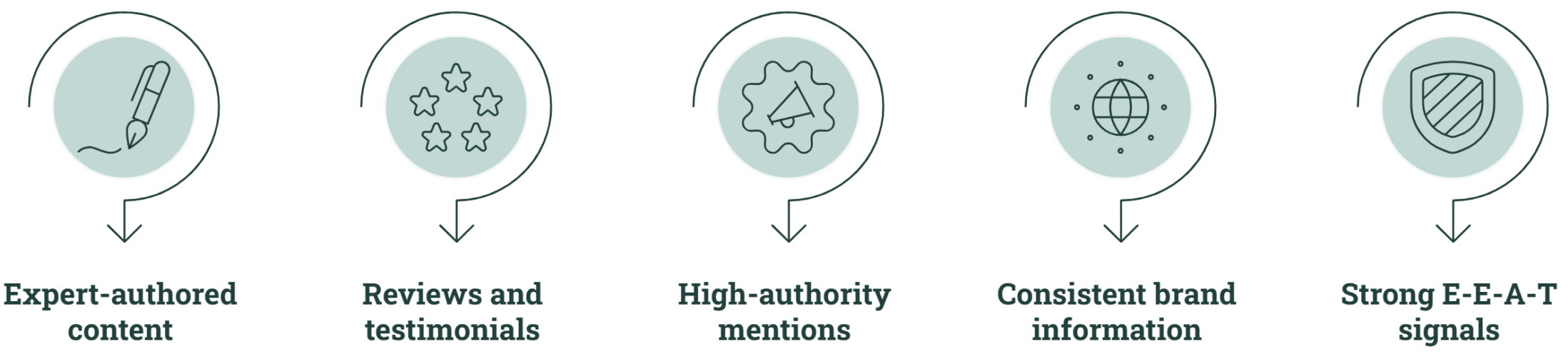
-
Expert-authored content:
Content with clear author credentials gives AI tools verifiable expertise to reference and cite with confidence. -
Reviews and testimonials:
Feedback from credible sources strengthens the authority profile AI systems build around your brand. -
High-authority mentions:
Mentions from industry publications, professional associations, and reputable websites carry significant weight when AI systems evaluate credibility and citation opportunities. -
Consistent brand information:
Maintaining accurate and consistent business information across all online platforms reduces ambiguity and strengthens entity recognition within AI systems. - Strong E-E-A-T signals:
Experience, Expertise, Authoritativeness, and Trustworthiness provide the foundation AI systems rely on when determining whether a brand is credible enough to cite.
Why Businesses Should Start Optimising for AI Search Now
The window for early-mover advantage exists right now. It will not stay open indefinitely.
Businesses that build AI search visibility now establish authority that becomes progressively harder for later entrants to displace. Content ecosystems take months to develop into credible authority signals. Relationships with authoritative publications take time to build. Entity recognition within AI systems develops through consistent, sustained effort.
Early advantages include:
- Earning AI citations before competitors establish authority in your specific niche
- Building the content depth that takes months to translate into genuine authority signals
- Establishing brand recognition within AI systems before your market becomes saturated with competitors pursuing the same strategy
Customer expectations are already shifting. Buyers expect AI tools to guide their decisions. Businesses that meet customers in those AI-generated moments earn trust at the earliest and most influential stage of the buying process.
Conclusion
AI search has permanently changed how customers find and evaluate businesses. Brands that appear in AI-generated answers earn trust and leads that their invisible competitors simply never see. The combination of entity optimisation, topical authority, expert content, and technical excellence builds the foundation for sustained AI visibility that compounds over time.
ChatGPT SEO services are no longer optional for businesses that depend on online visibility to generate customers. They are a core requirement for any brand that wants to remain visible and competitive as search continues to shift. The businesses building this foundation now will hold advantages that grow stronger year after year.
Redefining Web has contributed directly to this space, helping businesses navigate the move from traditional search rankings to AI-driven visibility through structured content strategies and authority-building programmes that align with how modern AI tools evaluate and cite online sources.
Ready to Increase Your AI Search Visibility
Frequently Asked Questions about ChatGPT SEO Services


Know your website’s SEO Score.
Get a customized SEO Audit report & improve your website statistics.